


Two decades ago I volunteered regularly at a free lunch program offered by a downtown church in Lubbock, Texas. From one to two hundred people came, mostly from the neighborhood. We ‘got them through the line, fed and cleaned up’ in an hour. For a reason I no longer remember, one day I decided to stand in line, get a plate and sit down at a table and get into a conversation with a couple of people. That was an important milestone in my journey into the heart of what the authors discuss in this book.
Although a relatively short book, it took me a while to read Friendship. The authors ask questions I thought I had satisfactorily answered a long time ago, and yet through their graceful interweaving of stories with the insight that comes from praxis, I found myself being challenged at the same time I was nodding in agreement with them. I took stock of some of the friendships I have, and confess I came out wanting. Having lived in Lexington for 9 months now, I became somewhat uncomfortable as I reflected on whether blossoming friendships here are truly mutual or if I’m still tempted to see certain people as “projects”, “potential donors” or “representatives of causes.” One of the strengths of the book is the honesty and humility evident throughout, which gently drew forth the same from me.
The book takes an unflinching yet generous look at donor-recipient issues in service and mission; at the unavoidable ambiguities and tensions that arise when we become friends with those outside our own social circles; and at the necessity of long-term commitment to place and people. The last chapter, which asks what kinds of spiritual practices help sustain friendships at the margins, seems particularly important. What will help us sustain long term commitment to each other – where does our hope come from, and how will we nurture it in the midst of our shared brokenness? (To that end I’m also looking forward to reading Pilgrimage of a Soul by Chris’ wife and partner in mission, Phileena, released next month.)
Friendship at the Margins – highly recommended.
Chris (from word made flesh) writes beautifully here of what it means to engage in meaningful mission in our day and age. he is writing in response to Jonathan’s wonderful book, “the wisdom of stability.”
"What keeps our faith cheerful is everywhere in daily life, a sign that faith rules through ordinary things: through cooking and small talk, through storytelling, making love, fishing, tending animals and sweet corn and flowers, through sports, music, and books, raising kids p; all the places where the gravy soaks in and grace shines through. Even in a time of elephantine vanity and greed, one never has to look far to see the campfires of gentle people."
-- Garrison Keillor
check out this post from Christine Sine at MSA where she references seedleaf.
http://godspace.wordpress.com/2010/05/06/edible-art-churches-and-backyards/
![logo[1]](https://blogger.googleusercontent.com/img/b/R29vZ2xl/AVvXsEgBjfdNB2S6Qsu2ebMHy14zoLiG_ZTth-1d3k5L6S6fQunJXF9y1W2DZBOIw_cLp_woBV8kM5Dtw9oI_vxPz2OAopOi-8obXWtFrqx_AxHjoPqmu6NyrHleKevMv8EaKzFRFocQ4g/s1600-h/logo%5B1%5D%5B3%5D.png "logo[1]")
please take a minute to demand this film in your city/region. just a couple of clicks and you can really help this film get the audience it deserves.
thanks
http://www.returntoelsalvador.com/blog/98 | The Vertical Self: How Biblical Faith Can Help Us Discover Who We Are in An Age of Self Obsession |
The Vertical Self - Mark Sayers
ATTENTION
Mark had my undivided attention with his Acknowledgements section. He gives thanks to his regional library for “saving me a small fortune in books and for a lifetime of learning.” So, from the beginning of my reading I considered Mark a kindred spirit.
STYLE
Mark writes with an uncommon grace. As I was reading this book I did feel like I had a wiser friend gently dispensing insight. Personal without being corny and deeply thoughtful without being overtly academic makes for a very compelling read. His personal stories and central thesis provide grounding for years of scholarly research.
AUDIENCE
Mark writes primarily to those of us engaged in “reshaping the church in the West.” He suggests that our efforts will ultimately fail, “because there is a huge unnamed problem with people inside the church.” (p.xviii) He goes on to argue that discipleship is both the problem and the way forward as the people of God reframe church practices for the sake of living out a more liberating, revolutionary, and life-embracing faithfulness.
AGREED
After 12 years of ‘life together’ with communality I tend to agree with Mark’s assertion. We really can find all kinds of creativity in the ways we ‘do church’ but still leave our lives just as vulnerable to the dehumanizing influence of that which is unholy. It is no surprise that hot on the heels of this book those other Aussie missionary marvels, the Hirsch’s, released a book on missional discipleship (Untamed).
HITTING HOME
I found this book personally challenging, a perfect companion during the Lenten season. Mark was able to help me think about my identity as a human person in relationship with the Creator God (the vertical self). I must admit my severe (and, for the most part, ungodly) cynicism whenever I come across the latest “find yourself” recipes for self-discovery – especially from Christian writers. I was curious to see how Mark would avoid pressing my buttons and I was delighted to catch myself deeply moved by a challenging message. Mark is calling us back to a biblical anthropology that affirms what it means to be a proper human being and he cleverly articulates how frequently this quest is interrupted by the push and shove of our LOUD culture. Mark urges the reader to think about this proper humanity in terms of holiness, an admittedly un-sexy idea for this day and age. Mark helps unpack a kind of holiness (wholeness) rooted in scripture and affirming of our deepest impulses. His writing about the redemption of desire was especially helpful for fasting efforts during Lent.
WANTING MORE
I would have loved to read more of Mark’s reflections of being human in terms of the life of the Trinity. Our image bearing, it seems to me, is only possible in communion with other human persons. How does holiness become more than a personal trait and carry over into cultural (trans)formation? I’m also on a kick about ‘place’ and would love to hear more from Mark about how geography informs the vertical self.
BUY (OR BORROW) THIS BOOK
I highly recommend this book to you. Fantastic for personal inventory and/or reading in a small group setting. Few writers are able to bring the big-picture into the same landscape as personal formation with the clarity and gentleness of Mark. And while you’re at it, pick up his other book, “the trouble with Paris” for a brilliant survey of the mess we make when we allow faith to be submitted to consumerism (my review is here).
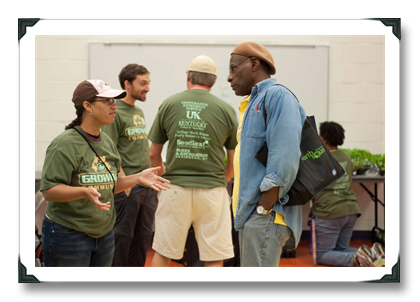
so many wonderful gatherings this weekend…and then several of our basements flooded. cups runneth over!
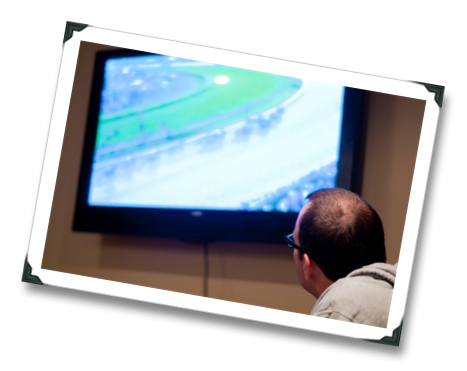
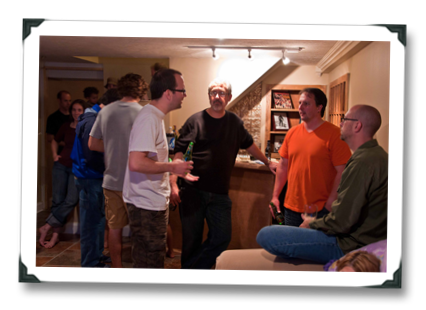
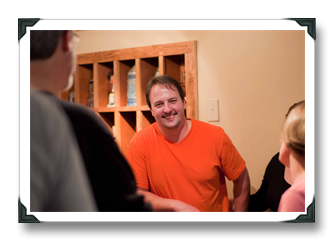
we had the growing community event in the east end, (saturday 10am-2pm), billy’s birthday party and derby gathering (saturday night), and the baby porter shower/celebration at the koch’s place (sunday morning). good times and even in the midst of soggy basements, some cherished community time.
here are some picture (see more here)




a wonderful post from christine sine.
…and here’s a taste:
Is This a Move of God?
Saturday I facilitated a Spirituality of Gardening seminar at the Mustard Seed House. A small but extremely enthusiastic group gathered to discuss basics of organic gardening and how we encounter God in the garden. Towards the end of the day we talked about the current move towards faith based community gardens that are springing up literally all over the world as churches discover they can not only produce food for their congregations but also help feed those at the margins.
jonathan talks about community in this 5min WOTP video…i’m honored to have my photos incorporated into this piece so if your a communality peep look out for your shining face.
Christian Community w/Jonathan Wilson-Hartgrve from The Work Of The People on Vimeo.
if i’m reading something other than fiction, it is usually because geoff has convinced me with a fair amount of cajoling that a book is worth my time. i didn’t need any form of convincing to start into jonathan wilson-hartgrove’s new book “the wisdom of stability.”
just from the first chapter alone, i feel like his gentle words (which read just like the sound of the slow drawl of his southern accent) resonate with a place in me that is still unresolved yet full of hope about the stability that can come from life in community. in one passage, jonathan quotes a saint of christian community, clarence jordan of the interracial community called koinonia farm in my home state of georgia. about the rising and falling tides of their life together, jordan claims, “this is what always baffles me. koinonia is forever dying and forever living. we should have conked out long ago, but somehow others came in the nick of time. this half-born condition is agonizing, and i could wish it otherwise, but there it is.”
jonathan goes on to reflect, “stability in community is always a half-born condition. we are suspended between heaven and earth on a ladder that promises communion with god but is also planted firmly on the ground…stability is a commitment to trust god not in an ideal world, but in the battered and bruised world we know. if real life with god can happen anywhere at all, then it can happen here among the people whose troubles are already evident to us…community is always a risk. we cannot know beforehand who will stay and who will leave. but each decision to stay – every prayer lifted up from our half-born condition – can be seen as an act of faith that our god will give us what we need, as clarence jordan said, ‘in the nick of time.’”
while reading this, i couldn’t help but recall the rich and mysterious observations of wendell berry in his “unsettling of america” in which he depicts this same kind of half-born condition from the lens of the condition of soil, “if healthy soil is full of death it is also full of life…nothing that dies is dead for very long. within this powerful economy, it seems that death occurs only for the good of life.” these things seep in slowly for me and help recast my sense of the last decade of life in this place with these people of communality, those still here, those long gone. i certainly receive the paradox and greyness of it all far better than a few years ago. i’m glad jonathan’s book about stability will give company, comfort and weight to this journey.
(sherry)there is a storm brewing out west. recent legislation adopted by AZ threatens to unearth our fear and hate a scape-goating inclinations. while the law of the land is important we are always challenged to affirm our ultimate obligation to the reign of God. our story tells us (without qualification)
“when an alien resides with you in your land, you shall not oppress the alien. The alien who resides with you shall be ot you as the citizen among you; you shall love the alien as yourself, for you were aliens in the land of Egypt: I an the Lord you God.” (my emphasis…Leviticus 19:33-34).
i know it is a complicated issue and i know there are qualifications to be made but this passage (and many like it) must be our touchstone…along with careful reflection on the way Jesus positioned himself in the public sphere where stones were cupped in white-knuckled hands.
this group is doing some good work to help frame a christian response…check it out. they say:
· We believe all people, regardless of national origin or citizenship status, are made in the "image of God" and deserve to be treated with dignity and respect (Genesis 1:26-27, 9:6).
· We believe there is an undeniable responsibility to love and show compassion for the stranger among us (Deuteronomy 10:18-19, Leviticus 19:33-34, Matthew 25:31-46).
· We believe that immigrants are our neighbors, both literally and figuratively, and we are to love our neighbors as ourselves and show mercy to neighbors in need (Leviticus 19:18, Mark 12:31, Luke 10:25-37).
· We believe in the rule of law, but we also believe that we are to oppose unjust laws and systems that harm and oppress people made in God's image, especially the vulnerable (Isaiah 10:1-4, Jeremiah 7:1-7, Acts 5:29, Romans 13:1-7).
We recognize that the current U.S. immigration system is broken and reform is necessary.
The biblical princples above compel us to support immigration reform legislation that includes the following elements:
· Enforcement initiatives that are consistent with humanitarian values;
· Reforms in our family-based immigration system that reduce waiting times for separated families to be reunited;
· A process for all immigrant workers and their families already in the U.S. to earn citizenship upon satisfaction of specific criteria;
· An expansion of legal avenues for workers and families to enter our country and work in a safe and legal manner with their rights and due process fully protected;
· Examining solutions to address the root causes of migration, such as economic disparities between sending and receiving nations.

