Friday, June 25, 2010

US Social Forum Update


It is hard to know where to begin sharing about the last couple of days. There is so much that has happened. But there is one thing that I've been contemplating for the last twelve hours that was brought to some degree of clarity during a walk that I took around downtown Detroit this afternoon. The photos that you see here help narrate that journey and the thoughts lately chattering in my mind. Last night we took a walk through the downtown area looking for a restaurant. During our walk we ended up taking a stroll through the MGM Grand casino that sits like a gleaming jewel just on the outskirts of the downtown core. I was absolutely astonished at the size of the crowd that was packed inside the casino on a Thursday night in an otherwise mostly dead downtown. A downtown that looks pretty dead even though the forum has brought thousands of people into the city. I didn't see any USSF wristbands in the casino, though I was observing closely. Anyhow, the scene was quite disturbing and it wasn't till my walk today that I was able to pin down with clarity the contours of the internal nagging.

We got a chance yesterday to listen to an amazing conversation between Grace Lee Boggs and Immanuel Wallerstein about the current state of world economic/social affairs. Wallerstein is one, among many, who has written about "dependency theory" in economics and its correlate the "Center-Periphery" model. In short, these interrelated concepts suggest that in a free-market capitalist system wealth and material resources are extracted from outlying peripheral areas (or countries) and concentrated in urban centers (or in a relatively small number of controlling countries). This is what really struck me as I took my walk today and spent some time outside the casino pondering. I will let you ponder and draw your own conclusions.

The other picture is of the DTE energy building directly across from the MGM. DTE was the target of a USSF participant organized protest earlier in the week. The protest derived from the controversy surrounding a purported 17 deaths that resulted from DTE terminating eletricity services to vulnerable residents who then succumbed to the elements. People should pay their bills, right? Who can argue with that? Again, I will let you draw your own conclusions. All I will say is that the takeaway for me, from my sojourn at the intersection of those two buildings, is the crucial reminder that one day I will be sitting down with Christ to talk about my life, my wife and family, my friends, my neighbors and what I did with what I had.

The final picture is of some chicory and other wildflowers growing in a vacant lot across from the aformentioned structures.....a little silent protest....a quiet reminder and source of hope.

So, in the backdrop of the aforegoing, there are many amazing things happening in Detroit. The large urban gardening movement is being carried on alongside other wonderful efforts we've learned about like Detroit Summer, the Allied Media Conference/Project and the Capuchin Soup Kitchen and garden. One of the themes here at the USSF has been that "Another Detroit is Happening." We can see that that is true in a great number of inspiring ways. And we can be even more proud and grateful for all the work that our friends and neighbors are doing in our own city. All of that has been very deeply confirmed and affirmed on this trip.

Wednesday, June 23, 2010

One possible missional model

This is a reprint of a post from 1996, whhich I wanted to share again this year.

************************************************************************

While I will always, in some sense, be a Texas girl at heart, I also love being out East. The spring brings blooming fruit trees and clusters of daffodils along the roads, and the fall has the gorgeous arrays of changing leaves. It's breathtaking.

Summer also has lots of stuff in bloom, many things which wouldn't grow in my arid hometown of Lubbock unless you spent the kids' inheritance on irrigation. I especially enjoy the June-blooming daylilies under our bedroom window. But I was thinking today about the summer arrival that I most anticipate -- the sudden bouquets of chicory in almost every corner of the city.
Chicory is really beautiful. It has sky-blue flowers that open every day. Its hardy, woody stems grow in nice clusters for good visual effect. And it seems to appear, without fail, just about everywhere. It grows alongside telephone poles, in vacant lots, and in cracks of sidewalk. It's quite the survivor. During a recent city meeting on planting flowers to beautify Lexington for the Equestrian Games, someone stressed the need to plant flowers which would thrive without constant attention, exposed to exhaust fumes and choking dust. I wanted to nominate chicory.

Interestingly, it doesn't do well as a cut flower. Try to bring it home for the vase on your counter, and it just wilts. It needs to be connected to its context, to the stems, to the soil. It wants to stay where it was planted.

There may be some lessons here for the Church. We've become quite adept at planting and nurturing beautiful seeds, which smell nice and undoubtedly bring beauty and grace into the world. The trouble is, so often they require too much work, attention, and care, whch could be going to other things. We need to take our cue, not from dainty blossoms that wilt under the baking sun or wither in the slighest drought, but from this hardy and intrepid pioneer. The Church needs no more hothouse flowers; what it (and the world) needs is bunches of chicory.

Tuesday, June 22, 2010

Initial US Social Forum foray

I drove up to Detroit today to meet up with Greg (Leffel) and Steve (Pavey) to begin our journey with the approximately 15 thousand people who've come to attend the US Social Forum. I had a smooth journey overall. It was actually kind of nice to spend time alone in the car. It was the first road trip of decent length that I've taken in a while. I guess if you're going to take a road trip (in a car) in America then Detroit is a pretty good destination.

I got to the hotel at 5:45 and walked over to Cobo Hall to join Greg, Steve and a new friend Craig at the opening ceremony. We took in about twenty minutes of the ceremony and then went to the commons area where we ran into Jai Sen whom we'd previously met at the World Forum in Belem, Brazil back in 2008. Jai Sen is an Indian scholar/activist who has become one of the primary archivists and networkers of the wider movement. We had a brief but good visit with him and enjoyed getting an update about his current work.

We went to dinner in the "Greektown" area and rode the elevated train that cuts through the downtown Detroit area. We were joking about the fact that the train was kind of like a model railroad because it just runs in a simple loop around the downtown and doesn't really get you anywhere that you can't get on foot or bike relatively quickly-not really public transport. It was apparently spearheaded by GM and is kind of a gift from the company to the city....a gift, noted Steve, that does little to challenge the hegemony of the car! Anyhow, just an observation...

Perhaps the most intriguing exchange of the day for me came when I was riding in a cab from the airport rental drop to the downtown. My cab driver was from Jordan but has lived in the US for about 20 years. He really wanted to know about the forum so I did my best to give him a brief explanation about how the forum was created to help create an alternative space to the World Economic Forum and its perceived economic reductionsim; a space where all participants, and their unique cultural and social considerations, could have a voice and the conversation is not dominated by the prevailing interests of the G8/G20. Anyhow, my guide was skeptical about the forum. Perhaps I did not do a good job of representing it. But I had to be amused when he said (paraphrase) "It is good for a small number of smart people to make decisions for all the rest....This is a good thing....as long they're thinking about all the people." Is that what we refer to as a "divine monarchy?"

Anyhow, miss my family and friends back home but glad to be here.....a good opportunity to listen, reflect, observe, be challenged and meet some new friends as well as spend some quality time with older ones.

Monday, June 21, 2010

sunday gathering

sarah and andrea shared some reflections on their recent participation in this conference.

rich discoveries and insight that will continue to serve our efforts at receiving the gift of reconciliation in our city.

communality in the community garden-14.jpg

communality in the community garden-11.jpg

communality in the community garden-8.jpg

communality in the community garden-2.jpg

communality in the community garden-5.jpg

communality in the community garden.jpg

Tuesday, May 25, 2010

in the park

wonderful gathering in the park this week.  that’s the sweet part…the bitter was also with us as we said farewell to the Aja and Bartlett tribes.  dear co-travelers for a small time and we will miss them.  we played and prayed, laughed and talked and shared in the meal of remembering. 

communality in the park

communality in the park

communality in the park

communality in the park

communality in the park

communality in the park

communality in the park

Tuesday, May 18, 2010

The Importance of hospitality

In a world where social and political discourse is so dominated by the (felt) need to capture and keep the "news-cycle," I find these words from Henri Nouwen very hopeful and challenging:

"Creating space for the other is far from an easy task. It requires hard concentration and articulate work. It is like the task of a patrolman trying to create some space in the middle of a mob of panic-driven people for an ambulance to reach the center of an accident. Indeed, more often than not rivalry and competition, desire for power and immediate results, impatience and frustration, and, most of all, plain fear make their forceful demands and tend to fill every possible empty corner of our life. Empty space tends to create fear. As long as our minds, hearts and hands are occupied we can avoid confronting the painful questions, to which we never gave much attention and which we do not want to surface. 'Being busy' has become a status symbol, and most people keep encouraging each other to keep their body and mind in constant motion. From a distance, it appears that we try to keep each other filled with words and actions, without tolerance for a moment of silence...But by filling every empty corner and occupying every empty time...hospitality becomes more oppressive than revealing.

Occupation and not empty space is what most of us are looking for. When we are not occupied we become restless. We even become fearful when we do not know what we will do for the next hour, the next day of the next year. Then occupation is called a blessing and emptiness a curse. Many telephone conversations begin with the words: 'I know you are busy, but...' and we would confuse the speaker and even harm our reputation were we to say, 'Oh no, I am completely free, today, tomorrow and the whole week.' Our client might well lose interest in a man who has so little to do.

So we can see that creating space is far from easy in our occupied and preoccupied society. And still, if we expect any salvation, redemption, healing and new life, the first thing we need is an open and receptive place where something can happen to us. Hospitality, therefore, is such an important attitude. We cannot change the world by a new plan, project or idea. We cannot even change other people by our convictions, stories, advice and proposals, but we can offer space where people are encouraged to disarm themselves, to lay aside their occupations and preoccupations and listen with attention and care to the voices speaking in their own center (selections from chapter 4, "Reaching Out")."

Monday, May 10, 2010

Book Review – Friendship at the Margins

Friendship at the Margins Friendship at the Margins is part of the Resources for Reconciliation Book Series, a partnership between IVP and the Center for Reconciliation at Duke Divinity School. The series asks what it means to pursue hope in the midst of the many manifestations of brokenness in our world. Each book is co-authored by a practitioner and someone from the academy. I have been looking forward to reading Friendship, written as it is by two people I have respected for a long time: Chris Heuertz, international director of Word Made Flesh, and Christine Pohl, professor of social ethics at Asbury Seminary, who was my advisor during my time there.

Two decades ago I volunteered regularly at a free lunch program offered by a downtown church in Lubbock, Texas. From one to two hundred people came, mostly from the neighborhood. We ‘got them through the line, fed and cleaned up’ in an hour. For a reason I no longer remember, one day I decided to stand in line, get a plate and sit down at a table and get into a conversation with a couple of people. That was an important milestone in my journey into the heart of what the authors discuss in this book.

Although a relatively short book, it took me a while to read Friendship. The authors ask questions I thought I had satisfactorily answered a long time ago, and yet through their graceful interweaving of stories with the insight that comes from praxis, I found myself being challenged at the same time I was nodding in agreement with them. I took stock of some of the friendships I have, and confess I came out wanting. Having lived in Lexington for 9 months now, I became somewhat uncomfortable as I reflected on whether blossoming friendships here are truly mutual or if I’m still tempted to see certain people as “projects”, “potential donors” or “representatives of causes.” One of the strengths of the book is the honesty and humility evident throughout, which gently drew forth the same from me.

The book takes an unflinching yet generous look at donor-recipient issues in service and mission; at the unavoidable ambiguities and tensions that arise when we become friends with those outside our own social circles; and at the necessity of long-term commitment to place and people. The last chapter, which asks what kinds of spiritual practices help sustain friendships at the margins, seems particularly important. What will help us sustain long term commitment to each other – where does our hope come from, and how will we nurture it in the midst of our shared brokenness? (To that end I’m also looking forward to reading Pilgrimage of a Soul by Chris’ wife and partner in mission, Phileena, released next month.)

Friendship at the Margins – highly recommended.

staying is the new going

Chris (from word made flesh) writes beautifully here of what it means to engage in meaningful mission in our day and age.   he is writing in response to Jonathan’s wonderful book, “the wisdom of stability.”

read the article

Friday, May 07, 2010

keeping our faith cheerful

"What keeps our faith cheerful is everywhere in daily life, a sign that faith rules through ordinary things: through cooking and small talk, through storytelling, making love, fishing, tending animals and sweet corn and flowers, through sports, music, and books, raising kids ­p; all the places where the gravy soaks in and grace shines through. Even in a time of elephantine vanity and greed, one never has to look far to see the campfires of gentle people."
-- Garrison Keillor

Something to consider

Here is something remarkable that I was contemplating in my morning reading. The GDP (Gross Domestic Product) of the United States for 2009 was over 6.25 times greater than that of the entire 53 countries of the continent of Africa. The GDP (GSP in this case) of the state of California alone in 2008 was over 80% of the GDP of the 53 countries of Africa for 2009. I know California is currently experiencing significant difficulties, as are many of the rest of us. I do not mean to downplay anyone's struggle, nor am I trying to build an argument based upon such a simple comparison. But as we engage in the very necessary debate about foreign aid (Sachs) vs. internal development (Easterly)-and attempt to discern what we feel is "Africa's responsibility"- I think it is critically important to continue to reflect upon and contemplate how much material wealth is controlled by the west. It seems that as Christians such contemplation could provide us with a strong measure of sobriety as we have these conversations. Perhaps it could help us to incarnate Christ in this debate (as well as the other, even more intense debates, about our own nation)?

List of African countries by GDP (PPP)
From Wikipedia, the free encyclopedia
Jump to: navigation, search

This is a list of African nations ranked by Gross Domestic Product (GDP) at Purchasing Power Parity (PPP). Figures are given in 2009 International Dollars according to the World Bank[1] 2009 figures.

This list excludes Somalia.
African Rank World Rank Country 2009 GDP (PPP)
millions of International dollars

— — Africa $2,200,100

1 25 Egypt 467,600
2 27 South Africa 403,900
3 37 Nigeria 294,800
4 38 Algeria 268,900
5 55 Morocco 127,000
6 61 Angola 93,100
7 62 Libya 90,600
8 66 Sudan 80,500
9 67 Tunisia 76,900
10 73 Ethiopia 61,600

List by the International Monetary Fund (2009)
Rank Country GDP (PPP) $M

— World 69,808,807
1— European Union 14,793,979
2 United States 14,256,275
3 People's Republic of China 8,765,240
4 Japan 4,159,432
5 India 3,526,124
6 Germany 2,806,266

gardening and faith

check out this post from Christine Sine at MSA where she references seedleaf.

http://godspace.wordpress.com/2010/05/06/edible-art-churches-and-backyards/

Tuesday, May 04, 2010

‘return to el salvador’ film

logo[1]

please take a minute to demand this film in your city/region.  just a couple of clicks and you can really help this film get the audience it deserves.

thanks

http://www.returntoelsalvador.com/blog/98

Monday, May 03, 2010

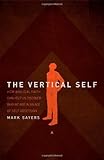
book review – the vertical self

The Vertical Self: How Biblical Faith Can Help Us Discover Who We Are in An Age of Self Obsession

The Vertical Self - Mark Sayers

ATTENTION

Mark had my undivided attention with his Acknowledgements section. He gives thanks to his regional library for “saving me a small fortune in books and for a lifetime of learning.” So, from the beginning of my reading I considered Mark a kindred spirit.

STYLE

Mark writes with an uncommon grace. As I was reading this book I did feel like I had a wiser friend gently dispensing insight. Personal without being corny and deeply thoughtful without being overtly academic makes for a very compelling read. His personal stories and central thesis provide grounding for years of scholarly research.

AUDIENCE

Mark writes primarily to those of us engaged in “reshaping the church in the West.” He suggests that our efforts will ultimately fail, “because there is a huge unnamed problem with people inside the church.” (p.xviii) He goes on to argue that discipleship is both the problem and the way forward as the people of God reframe church practices for the sake of living out a more liberating, revolutionary, and life-embracing faithfulness.

AGREED

After 12 years of ‘life together’ with communality I tend to agree with Mark’s assertion. We really can find all kinds of creativity in the ways we ‘do church’ but still leave our lives just as vulnerable to the dehumanizing influence of that which is unholy. It is no surprise that hot on the heels of this book those other Aussie missionary marvels, the Hirsch’s, released a book on missional discipleship (Untamed).

HITTING HOME

I found this book personally challenging, a perfect companion during the Lenten season. Mark was able to help me think about my identity as a human person in relationship with the Creator God (the vertical self). I must admit my severe (and, for the most part, ungodly) cynicism whenever I come across the latest “find yourself” recipes for self-discovery – especially from Christian writers. I was curious to see how Mark would avoid pressing my buttons and I was delighted to catch myself deeply moved by a challenging message. Mark is calling us back to a biblical anthropology that affirms what it means to be a proper human being and he cleverly articulates how frequently this quest is interrupted by the push and shove of our LOUD culture. Mark urges the reader to think about this proper humanity in terms of holiness, an admittedly un-sexy idea for this day and age. Mark helps unpack a kind of holiness (wholeness) rooted in scripture and affirming of our deepest impulses. His writing about the redemption of desire was especially helpful for fasting efforts during Lent.

WANTING MORE

I would have loved to read more of Mark’s reflections of being human in terms of the life of the Trinity. Our image bearing, it seems to me, is only possible in communion with other human persons. How does holiness become more than a personal trait and carry over into cultural (trans)formation? I’m also on a kick about ‘place’ and would love to hear more from Mark about how geography informs the vertical self.

BUY (OR BORROW) THIS BOOK

I highly recommend this book to you. Fantastic for personal inventory and/or reading in a small group setting. Few writers are able to bring the big-picture into the same landscape as personal formation with the clarity and gentleness of Mark. And while you’re at it, pick up his other book, “the trouble with Paris” for a brilliant survey of the mess we make when we allow faith to be submitted to consumerism (my review is here).

Sunday, May 02, 2010

overflowing weekend

so many wonderful gatherings this weekend…and then several of our basements flooded. cups runneth over!

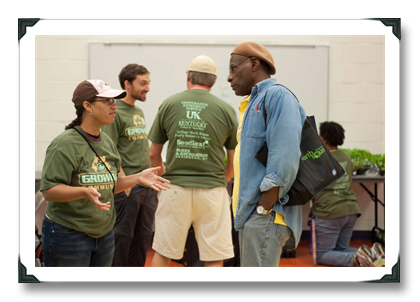
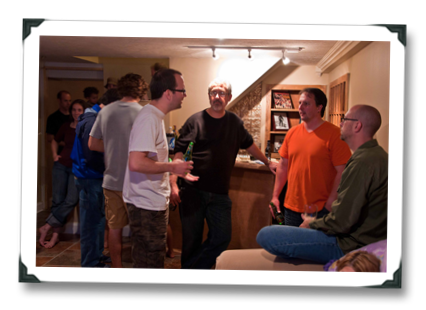
we had the growing community event in the east end, (saturday 10am-2pm), billy’s birthday party and derby gathering (saturday night), and the baby porter shower/celebration at the koch’s place (sunday morning).  good times and even in the midst of soggy basements, some cherished community time.

here are some picture (see more here)

Friday, April 30, 2010

gardening and god

a wonderful post from christine sine.

here

…and here’s a taste:

Is This a Move of God?

Saturday I facilitated a Spirituality of Gardening seminar at the Mustard Seed House.  A small but extremely enthusiastic group gathered to discuss basics of organic gardening and how we encounter God in the garden.  Towards the end of the day we talked about the current move towards faith based community gardens that are springing up literally all over the world as churches discover they can not only produce food for their congregations but also help feed those at the margins.