can you believe this?
"The federal minimum wage bill has been folded into the Iraq war spending legislation now before Congress. Whatever the political maneuvers that led to this situation, it is clear Congressional leadership has lost sight of the value of working men and women in our nation who have gone too long without a raise. " (read the rest here)
is it any wonder people (like me) are cynical about the political process? it seems near impossible to do justice. i am a long way from home right now but i hope (and trust) this has stirred some interest and passionate disgust in the US.
Thursday, March 15, 2007


Wednesday, March 07, 2007
An Uncommon Prayer
This is a prayer by our much-loved Michael Leunig, an Australian prophet and cartoonist. It is quoted at the start of a book I'm reading with a group of women here. The book is "Not Religion but Love - practising a radical spirituality of compassion" by Dave Andrews.
"God help us. With great skill and energy, we have ignored the state of the human heart. With eloquence and wit we have belittled the heart's wisdom. With politics and economics we have denied the heart's needs. With science and technology we have drowned out the voice of the soul. The primitive voice - the innocent voice - the truth.
We cannot hear the heart's truth, and thus we have betrayed and belittled ourselves and pledged madness to our children...We have made for ourselves an unhappy society.
It is timely that we give thanks for the lives of all prophets, teachers, healers, and revolutionaries, living and dead, acclaimed or obscure, who have rebelled, worked, and suffered for the cause of love and joy. We also celebrate that part of us, that part of us within ourselves, which has rebelled, worked, and suffered for the cause of love and joy.
God help us to change. To change ourselves and to change our world. To know the need for it. To deal with the pain of it. To feel the joy of it. To undertake the journey without understanding the destination.
That which is Christ-like within us shall be crucified. It shall suffer and be broken. And that which is Christ-like within us shall rise up. It shall love and create."
From A Common Prayer by Michael Leunig
(sherry)
"God help us. With great skill and energy, we have ignored the state of the human heart. With eloquence and wit we have belittled the heart's wisdom. With politics and economics we have denied the heart's needs. With science and technology we have drowned out the voice of the soul. The primitive voice - the innocent voice - the truth.
We cannot hear the heart's truth, and thus we have betrayed and belittled ourselves and pledged madness to our children...We have made for ourselves an unhappy society.
It is timely that we give thanks for the lives of all prophets, teachers, healers, and revolutionaries, living and dead, acclaimed or obscure, who have rebelled, worked, and suffered for the cause of love and joy. We also celebrate that part of us, that part of us within ourselves, which has rebelled, worked, and suffered for the cause of love and joy.
God help us to change. To change ourselves and to change our world. To know the need for it. To deal with the pain of it. To feel the joy of it. To undertake the journey without understanding the destination.
That which is Christ-like within us shall be crucified. It shall suffer and be broken. And that which is Christ-like within us shall rise up. It shall love and create."
From A Common Prayer by Michael Leunig
(sherry)
Monday, March 05, 2007
the greatest moral crisis of our age
Here is an article from Matthew...see this NY Times piece for the background.
Caring for Creation: The Greatest Moral Crisis of Our Age
J. Matthew Sleeth, MD
Jim Dobson is at it again. He and several conservative Christian groups sent a letter urging the National Association of Evangelicals to force its policy director in Washington to stop speaking out on global warming.
It’s time to stop this nonsense. As a physician, environmentalist, and evangelical Christian, I can state without reservation that global warming is real and that it is harming the least among us—our less fortunate global neighbors—disproportionately.
The Bible repeatedly commands us to demonstrate our love for the Creator by caring for His creation. We are further told to love our neighbor, particularly the least among us who are hurt most by our profligate use of resources, by stewarding God’s blessings wisely.
Until six years ago, I was director of an emergency room and chief of the medical staff of a beautiful hospital in New England. I had all the trappings of the American Dream—a big house in a postcard-perfect seaside village, two luxury cars, and lots of stuff. Then in one week’s time I admitted three women in their thirties with breast cancer, all to die. I decided that it was time to “stop running for the cure,” and to start looking for the cause.
A few months later, while on vacation, my wife asked me what I thought was the biggest problem facing the world today. I answered, “The earth is dying.” Then why we aren’t we doing something about it, she countered.
I thought I was. We had raised our children in cloth diapers, recycled religiously, and never driven anything more powerful than a four-cylinder car. But the Bible calls me to take the plank out of my own eye before I worry about the speck in my neighbor’s. So my family took an accounting and found that our energy usage was exactly average for America—which is unethically hoggish in global terms. Yes, compared to other physicians, my family was using less, but the Bible tells us to measure our lives against the example set by Jesus. When held against His humble life of service—Jesus never owned a home, had more than one cloak, or rode except on a borrowed colt, once—my consumerist lifestyle was indefensible.
Over the next year, my family embarked on a spiritual and environmental journey that resulted in us cutting back our electricity usage to one-tenth the national average and our fossil fuel use to one-third. We gave away half our possessions and moved into a house with the same footprint of our old garage. (Don’t feel too sorry for me; we had a big garage.) Along the way, my wife, two teenaged children, and I all were born again in a new and better life with God. I quit my job and began speaking, preaching, and writing full time about faith and the environment. Recently, my wife Nancy—who teaches at an evangelical Christian college—was talking to a young woman studying environmental science. Their family has owned the same 1400 acres in the Bible belt for a dozen generations, and they have always supported conservative politics. The young woman was being chided by her sister for investing so much of her energies in creation care. Like Dobson, her sister argued that other issues, like abortion and homosexuality, are more important. The college student replied that there will be no planet for any babies to be born on, or for any of these moral issues to be played out, if we do not start using our resources more wisely.
What this young woman was saying, and what many Christians are beginning to believe, is that caring for creation is the biggest moral crisis of our day. Like the slavery crisis of two centuries ago, we are importing cheap energy to support a lush lifestyle at the expense of our global neighbors, particularly those with fewer resources. And like the abolitionist movement, and the civil rights movement, we will need moral leadership from our faith communities if we have any hope of making significant change.
In January I was fortunate to speak at Wheaton College along with Sir John Houghton, the world’s preeminent climatologist, co-chair of the Intergovernmental Panel on Climate Change, and an evangelical Christian. He stated that China, India, and the emerging world are waiting to see what the United States will do about global warming. If we, with all our resources and wealth, are not willing to make some sacrifices, why should they? And Congress is waiting to see if the church will take on this issue. If their constituency, which is 85 percent Christian, doesn't care, why should they? And so, Sir John argues, the fate of the earth comes down to the evangelical Christian community in America. If we take on this issue, we will see a world-changing ripple effect. If not, there is little hope, especially for those inhabiting emerging nations.
Will humans survive global warming? The simple answer: Yes, but only those who can afford to. Rich countries will spend trillions of dollars adapting to the inevitable changes. People in poor countries will starve or migrate.
So what is the ethical response to global warming? As Christians, we—including Jim Dobson—should start by acknowledging our complicity. The vast majority of our resource consumption does nothing to glorify God. In fact, it does just the opposite.
As in any moral dilemma, evangelical Christians look to the Bible for wisdom. We are commanded to be the hands and feet of our Lord. In Christ’s most known sermon, given on a mountain, He tells us that “the meek shall inherit the earth.” We must set an example by the way we live our lives and steward limited resources. Are Americans of faith ready to put aside their squabbles and begin working together to solve the greatest moral issue of our day? Nothing less than the fate of God’s creation depends on our answer.
Dr. J. Matthew Sleeth is author of Serve God, Save the Planet, A Christian Call to Action, which is being released in softcover by Zondervan Publishing this month. For more information, see www.servegodsavetheplanet.org
Caring for Creation: The Greatest Moral Crisis of Our Age
J. Matthew Sleeth, MD
Jim Dobson is at it again. He and several conservative Christian groups sent a letter urging the National Association of Evangelicals to force its policy director in Washington to stop speaking out on global warming.
It’s time to stop this nonsense. As a physician, environmentalist, and evangelical Christian, I can state without reservation that global warming is real and that it is harming the least among us—our less fortunate global neighbors—disproportionately.
The Bible repeatedly commands us to demonstrate our love for the Creator by caring for His creation. We are further told to love our neighbor, particularly the least among us who are hurt most by our profligate use of resources, by stewarding God’s blessings wisely.
Until six years ago, I was director of an emergency room and chief of the medical staff of a beautiful hospital in New England. I had all the trappings of the American Dream—a big house in a postcard-perfect seaside village, two luxury cars, and lots of stuff. Then in one week’s time I admitted three women in their thirties with breast cancer, all to die. I decided that it was time to “stop running for the cure,” and to start looking for the cause.
A few months later, while on vacation, my wife asked me what I thought was the biggest problem facing the world today. I answered, “The earth is dying.” Then why we aren’t we doing something about it, she countered.
I thought I was. We had raised our children in cloth diapers, recycled religiously, and never driven anything more powerful than a four-cylinder car. But the Bible calls me to take the plank out of my own eye before I worry about the speck in my neighbor’s. So my family took an accounting and found that our energy usage was exactly average for America—which is unethically hoggish in global terms. Yes, compared to other physicians, my family was using less, but the Bible tells us to measure our lives against the example set by Jesus. When held against His humble life of service—Jesus never owned a home, had more than one cloak, or rode except on a borrowed colt, once—my consumerist lifestyle was indefensible.
Over the next year, my family embarked on a spiritual and environmental journey that resulted in us cutting back our electricity usage to one-tenth the national average and our fossil fuel use to one-third. We gave away half our possessions and moved into a house with the same footprint of our old garage. (Don’t feel too sorry for me; we had a big garage.) Along the way, my wife, two teenaged children, and I all were born again in a new and better life with God. I quit my job and began speaking, preaching, and writing full time about faith and the environment. Recently, my wife Nancy—who teaches at an evangelical Christian college—was talking to a young woman studying environmental science. Their family has owned the same 1400 acres in the Bible belt for a dozen generations, and they have always supported conservative politics. The young woman was being chided by her sister for investing so much of her energies in creation care. Like Dobson, her sister argued that other issues, like abortion and homosexuality, are more important. The college student replied that there will be no planet for any babies to be born on, or for any of these moral issues to be played out, if we do not start using our resources more wisely.
What this young woman was saying, and what many Christians are beginning to believe, is that caring for creation is the biggest moral crisis of our day. Like the slavery crisis of two centuries ago, we are importing cheap energy to support a lush lifestyle at the expense of our global neighbors, particularly those with fewer resources. And like the abolitionist movement, and the civil rights movement, we will need moral leadership from our faith communities if we have any hope of making significant change.
In January I was fortunate to speak at Wheaton College along with Sir John Houghton, the world’s preeminent climatologist, co-chair of the Intergovernmental Panel on Climate Change, and an evangelical Christian. He stated that China, India, and the emerging world are waiting to see what the United States will do about global warming. If we, with all our resources and wealth, are not willing to make some sacrifices, why should they? And Congress is waiting to see if the church will take on this issue. If their constituency, which is 85 percent Christian, doesn't care, why should they? And so, Sir John argues, the fate of the earth comes down to the evangelical Christian community in America. If we take on this issue, we will see a world-changing ripple effect. If not, there is little hope, especially for those inhabiting emerging nations.
Will humans survive global warming? The simple answer: Yes, but only those who can afford to. Rich countries will spend trillions of dollars adapting to the inevitable changes. People in poor countries will starve or migrate.
So what is the ethical response to global warming? As Christians, we—including Jim Dobson—should start by acknowledging our complicity. The vast majority of our resource consumption does nothing to glorify God. In fact, it does just the opposite.
As in any moral dilemma, evangelical Christians look to the Bible for wisdom. We are commanded to be the hands and feet of our Lord. In Christ’s most known sermon, given on a mountain, He tells us that “the meek shall inherit the earth.” We must set an example by the way we live our lives and steward limited resources. Are Americans of faith ready to put aside their squabbles and begin working together to solve the greatest moral issue of our day? Nothing less than the fate of God’s creation depends on our answer.
Dr. J. Matthew Sleeth is author of Serve God, Save the Planet, A Christian Call to Action, which is being released in softcover by Zondervan Publishing this month. For more information, see www.servegodsavetheplanet.org
Wednesday, February 28, 2007
paradise
i checked out a johnny cash 2-disc yesterday at the library and have been enjoying the old school tunes. one in particular was catchy, but told a pretty sad story. it's called "paradise" and is the cover of an old john prine song. it has a bit of a mountain top removal theme. since geoff's been out of town i haven't been paying much attention to the subject of mtr. this was a good reminder of what's going on to land that's so close. and to be mindful of the electricity that we use on a daily basis. in kentucky, 97% of electricity comes from coal. more kentucky mtr facts.
PARADISE by JOHN PRINE
When I was a child my family would travel
Down to Western Kentucky where my parents were born
And there's a backwards old town that's often remembered
So many times that my memories are worn.
Chorus:
And daddy won't you take me back to Muhlenberg County
Down by the Green River where Paradise lay
Well, I'm sorry my son, but you're too late in asking
Mister Peabody's coal train has hauled it away
Well, sometimes we'd travel right down the Green River
To the abandoned old prison down by Adrie Hill
Where the air smelled like snakes and we'd shoot with our pistols
But empty pop bottles was all we would kill.
Then the coal company came with the world's largest shovel
And they tortured the timber and stripped all the land
Well, they dug for their coal till the land was forsaken
Then they wrote it all down as the progress of man.
When I die let my ashes float down the Green River
Let my soul roll on up to the Rochester dam
I'll be halfway to Heaven with Paradise waitin'
Just five miles away from wherever I am.
PARADISE by JOHN PRINE
When I was a child my family would travel
Down to Western Kentucky where my parents were born
And there's a backwards old town that's often remembered
So many times that my memories are worn.
Chorus:
And daddy won't you take me back to Muhlenberg County
Down by the Green River where Paradise lay
Well, I'm sorry my son, but you're too late in asking
Mister Peabody's coal train has hauled it away
Well, sometimes we'd travel right down the Green River
To the abandoned old prison down by Adrie Hill
Where the air smelled like snakes and we'd shoot with our pistols
But empty pop bottles was all we would kill.
Then the coal company came with the world's largest shovel
And they tortured the timber and stripped all the land
Well, they dug for their coal till the land was forsaken
Then they wrote it all down as the progress of man.
When I die let my ashes float down the Green River
Let my soul roll on up to the Rochester dam
I'll be halfway to Heaven with Paradise waitin'
Just five miles away from wherever I am.
Tuesday, February 27, 2007
contaminations
Dad passed an article on to be by Ron Nikkel (president of Prison Fellowship International). you can find his past articles here - it is part Nikkel's 'Conversatio Morum' newsletter series and is entitled 'Contaminations'.
his reflection surrounds Jesus warning to his disciples, "beware of the yeast of the pharisees" (Matt. 16:6). This article is particularly interesting given that his former boss, Chuck Colson, has been one of the more outspoken 'friends' of the current administration (which of course offers the same risks to Christians as all the previous administrations). here are the last few paragraphs. i'm very challenged by it thinking through my own expectations for world peace or my own need for bread.
"One day as Jesus was preparing to launch out across the sea, his disciples were arguing amongst themselves about the lack of planning and preparation for their voyage. There was no lunch for the journey – whose responsibility was it anyhow? What good was a single loaf of bread between them? “Beware of the contaminating influence of the Pharisees and of Herod,” Jesus remarked as he stepped into the boat with them. Somewhat perplexed by his comment, the disciples muttered to themselves, “It must be because we did not bring the bread.” On hearing their continuing argument Jesus asked them to recall the recent feeding of the multitudes when but a single lunch had been available and yet sufficient to feed thousands. How quickly the lesson of trusting in God’s power and provision had been forgotten.
How easily we, like the disciples, become contaminated by the ways of the Pharisees and of Herod in our day. The contaminating influence of thinking like Pharisees lies in acting as if true religion is about believing, speaking, and doing the accepted and prescribed things of faith – and that God cares only for the good and for things beyond our reach. When the Pharisees were confronted with Jesus, who acted “outside that religious box,” again and again they demanded a miraculous sign -- real proof. How could the holy God of heaven possibly involve himself with the simple mundane needs of life like bread and wine, or stoop to care for loose women or Iraqi insurgents? But the fact is that God did – and still does.
The contamination of Herod is not religious at all, but down to earth and most pragmatic. It is all about being competent and in control – mastering the details of our own lives and those of others. Politics and performance becomes god-of-the-day under whom we assume responsibility for ourselves and the world. We bless and blame our own effort and responsibility as if lunch and life and the state of nations are completely in the hands of our own responsibility.
Beware of the contaminating influence of the Pharisees, by which we marginalize God to the higher things of heaven, disinterested in rough, routine and earthly stuff like the bread we need for the voyage or the lives of suicide bombers who threaten us in Afghanistan. Beware of the contaminating influence of Herod, by which we replace God with our own political sensibility and the competence of our own planning and preparation to secure bread for lunch and oil for our cars.
Believe in God, trust God – the One who turned water into wine for a wedding; who fed a multitude with a few loaves and fish; who dared to touch an unclean leper; who dined with sinners and prostitutes; who calmed the stormy sea – He is the God who cares for you in all the places and circumstances of your life."
his reflection surrounds Jesus warning to his disciples, "beware of the yeast of the pharisees" (Matt. 16:6). This article is particularly interesting given that his former boss, Chuck Colson, has been one of the more outspoken 'friends' of the current administration (which of course offers the same risks to Christians as all the previous administrations). here are the last few paragraphs. i'm very challenged by it thinking through my own expectations for world peace or my own need for bread.
"One day as Jesus was preparing to launch out across the sea, his disciples were arguing amongst themselves about the lack of planning and preparation for their voyage. There was no lunch for the journey – whose responsibility was it anyhow? What good was a single loaf of bread between them? “Beware of the contaminating influence of the Pharisees and of Herod,” Jesus remarked as he stepped into the boat with them. Somewhat perplexed by his comment, the disciples muttered to themselves, “It must be because we did not bring the bread.” On hearing their continuing argument Jesus asked them to recall the recent feeding of the multitudes when but a single lunch had been available and yet sufficient to feed thousands. How quickly the lesson of trusting in God’s power and provision had been forgotten.
How easily we, like the disciples, become contaminated by the ways of the Pharisees and of Herod in our day. The contaminating influence of thinking like Pharisees lies in acting as if true religion is about believing, speaking, and doing the accepted and prescribed things of faith – and that God cares only for the good and for things beyond our reach. When the Pharisees were confronted with Jesus, who acted “outside that religious box,” again and again they demanded a miraculous sign -- real proof. How could the holy God of heaven possibly involve himself with the simple mundane needs of life like bread and wine, or stoop to care for loose women or Iraqi insurgents? But the fact is that God did – and still does.
The contamination of Herod is not religious at all, but down to earth and most pragmatic. It is all about being competent and in control – mastering the details of our own lives and those of others. Politics and performance becomes god-of-the-day under whom we assume responsibility for ourselves and the world. We bless and blame our own effort and responsibility as if lunch and life and the state of nations are completely in the hands of our own responsibility.
Beware of the contaminating influence of the Pharisees, by which we marginalize God to the higher things of heaven, disinterested in rough, routine and earthly stuff like the bread we need for the voyage or the lives of suicide bombers who threaten us in Afghanistan. Beware of the contaminating influence of Herod, by which we replace God with our own political sensibility and the competence of our own planning and preparation to secure bread for lunch and oil for our cars.
Believe in God, trust God – the One who turned water into wine for a wedding; who fed a multitude with a few loaves and fish; who dared to touch an unclean leper; who dined with sinners and prostitutes; who calmed the stormy sea – He is the God who cares for you in all the places and circumstances of your life."
Tuesday, February 20, 2007
I'm Not Icharus
I wish I was just standing on the edge today, but I must say that it feels more like I'm running.
Peering to the left I see the cavernous depth drop below, like the gullet of a hungry monster opening for a gulp.
Run, run, running I am from everything I thought I used to know; is this the place to where, with the wind, I'm blown?
Any more force and over the edge I shall go.
Oh, to have wings on my ankles, I'd fly through the sky with the wisdom of hindsight.
I want to tell my story without someone else holding the pen; I want to jump off of this ledge without the darkness below; I want to fly high but not to burning heights.
I want to be free, but I'm not Icharus,
so maybe I'll put out my sails and find out where the wind will blow.
"The wind blows where it chooses, and you hear the sound of it, but you do not know where it comes from or where it goes. So it is with everyone who is born of the Spirit" (John 3:8).
(from Dan Lowe)
Peering to the left I see the cavernous depth drop below, like the gullet of a hungry monster opening for a gulp.
Run, run, running I am from everything I thought I used to know; is this the place to where, with the wind, I'm blown?
Any more force and over the edge I shall go.
Oh, to have wings on my ankles, I'd fly through the sky with the wisdom of hindsight.
I want to tell my story without someone else holding the pen; I want to jump off of this ledge without the darkness below; I want to fly high but not to burning heights.
I want to be free, but I'm not Icharus,
so maybe I'll put out my sails and find out where the wind will blow.
"The wind blows where it chooses, and you hear the sound of it, but you do not know where it comes from or where it goes. So it is with everyone who is born of the Spirit" (John 3:8).
(from Dan Lowe)
it's worth doing nothing and having a rest
this is dedicated to my dear friend mr ryan koch...and to all my communality family who struggle with an overactive protestant work ethic (you might not know who you are...ask ryan).
thanks to Simon Carey Holt (prof. of practical theology at Ridley in Melbourne).
(From Mr. Curly to Vasco Pyjama)
Dear Vasco,
In response to your question, “What is worth doing and what is worth having?” I would like to say simply this. It is worth doing nothing and having a rest; in spite of all the difficulty it may cause, you must rest, Vasco — otherwise you will become RESTLESS! I believe the world is sick with exhaustion and dying of restlessness.
While it is true that periods of weariness help the spirit to grow, the prolonged, ongoing state of fatigue, to which our world seems to be rapidly adapting, is ultimately soul-destroying as well as earth-destroying. The ecology of evil flourishes and love cannot take root in this sad situation. Tiredness is one of our strongest, most noble and instructive feelings. It is an important aspect of our CONSCIENCE and must be heeded or else we will not survive.
When you are tired you must HAVE that feeling and you must act upon it sensibly — you MUST rest like the trees and animals do. Yet tiredness has become a matter of shame! This is a dangerous development. Tiredness has become the most suppressed feeling in the world. Everywhere we see people overcoming their exhaustion and pushing on with intensity — cultivating the great mass mania which all around is making life so hard and ugly — so cruel and meaningless — so utterly graceless — and being congratulated for overcoming it and pushing it deep down inside themselves as if it were a virtue to do this.
And of course, Vasco, you know what happens when such strong and natural feelings are denied — they turn into the most powerful and bitter poisons with dreadful consequences. We live in a world of these consequences and then wonder why we are so unhappy.
So I gently urge you, Vasco, do as we do in Curly Flat — learn to curl up and rest — feel your noble tiredness — learn about it and make a generous place for it in your life and enjoyment with surely follow.
I repeat: it’s worth doing nothing and having a rest.
Yours sleepily, Mr. Curly x x x
The Curly Pyjama Letters (by Michael Leunig,Viking, 2001, 26-28.)
thanks to Simon Carey Holt (prof. of practical theology at Ridley in Melbourne).
(From Mr. Curly to Vasco Pyjama)
Dear Vasco,

In response to your question, “What is worth doing and what is worth having?” I would like to say simply this. It is worth doing nothing and having a rest; in spite of all the difficulty it may cause, you must rest, Vasco — otherwise you will become RESTLESS! I believe the world is sick with exhaustion and dying of restlessness.
While it is true that periods of weariness help the spirit to grow, the prolonged, ongoing state of fatigue, to which our world seems to be rapidly adapting, is ultimately soul-destroying as well as earth-destroying. The ecology of evil flourishes and love cannot take root in this sad situation. Tiredness is one of our strongest, most noble and instructive feelings. It is an important aspect of our CONSCIENCE and must be heeded or else we will not survive.
When you are tired you must HAVE that feeling and you must act upon it sensibly — you MUST rest like the trees and animals do. Yet tiredness has become a matter of shame! This is a dangerous development. Tiredness has become the most suppressed feeling in the world. Everywhere we see people overcoming their exhaustion and pushing on with intensity — cultivating the great mass mania which all around is making life so hard and ugly — so cruel and meaningless — so utterly graceless — and being congratulated for overcoming it and pushing it deep down inside themselves as if it were a virtue to do this.
And of course, Vasco, you know what happens when such strong and natural feelings are denied — they turn into the most powerful and bitter poisons with dreadful consequences. We live in a world of these consequences and then wonder why we are so unhappy.
So I gently urge you, Vasco, do as we do in Curly Flat — learn to curl up and rest — feel your noble tiredness — learn about it and make a generous place for it in your life and enjoyment with surely follow.
I repeat: it’s worth doing nothing and having a rest.
Yours sleepily, Mr. Curly x x x
The Curly Pyjama Letters (by Michael Leunig,Viking, 2001, 26-28.)
seeing the light
(we posted this over at our family blog also)
great news today from the australian federal government. they are phasing out the old-style light bulbs. see the story
here.
good on you, aussies.
(geoff)
great news today from the australian federal government. they are phasing out the old-style light bulbs. see the story
here.
good on you, aussies.
(geoff)
Monday, February 19, 2007
Kentucky Refugee Ministries event this weekend
Kentucky Refugee Ministries
invites you to join us on
Friday, February 23rd at 7:10 PM
at the
Kentucky Theatre
for the showing of
GOD GREW TIRED OF US
(Pre-show entertainment at 6:30 PM)
This is a film about young Sudanese refugees, and it is the winner of the Grand Jury Prize and the Audience Award at the Sundance Film Festival.
Performance by Lexington Children's Drum Choir before the film, a short presentation by loca refugees, and a photographic display.
Saturday, February 17, 2007
Communality Feature in Herald-Leader
In case you all missed it, Communality was featured in today's Herald-Leader. Here is the link: House Church.
Friday, February 16, 2007
Building a wall.......
Several weeks ago we began building a new room in the basement of the Golfview House (a community home intended for men in transition). Scott Morehead has done the overwhelming majority of the work and it is turning out to look very nice. I had the chance to join him for a few hours one Saturday afternoon to help frame-up one of the walls and install some insulation. The process of building a wall is something that is very satisfying. It is a tangible project that has a measurable easy to define ending point; once it is finished it requires little or no further work and is simply there for your enjoyment and use. This kind of finite outcome is very different than what we find in the relationships that we build with one another. Relationships require almost constant effort, can never be taken for granted, and do not provide us with the same kind of tidy ending point. This is something that Scott and I discussed as we built the wall. It is hard to keep up the near constant effort required to make a relationship work. And it is especially hard to maintain that effort, to make room (thanks Christine Pohl for this concept!) for others in your life, when relationships sour or disappoint; and this is something that inevitably happens when you try to love your neighbor. We have certainly had our share of disappointments with the Golfview House. Sometimes, in my darker moments, it seems like the whole effort has been in vain, and I wonder why we continue to make such efforts. However, there is something incredibly pure, inspiring, and revitalizing about building a wall together; there is something umistakably holy about preparing a place where someone else can live and hopefully find security, even if that person chooses not to take advantage of the opportunity. So I find myself, in the face of all my personal doubts and demons, returning to the sacred task of trying to make and prepare room for others. Indeed, I think that this is the fundamental act of God in creation, calling forth light out of darkness, order out of chaos; God willed creation to be,goodness to flow, and freedom to reign even though evil threatened to impinge upon it. We've been studying the Book of John in our small group at the Golfview House, and this past Wednesday we looked at the first chapter. We talked about how God chose to take on human flesh and "move into the neighborhood (thank you Eugene Peterson!); a neighborhood where the neighbors insulted him, falsely accused him, tortured him, and then murdered him! Wow! And John says that Jesus built this very neighborhood......he's the general contractor of the cosmos! How incredible it is that Jesus, who created everything that exists, and welcomed us all into the grand party of creation, embraces and loves us in the midst of our very unneighborly, dastardly, and even murderous behavior! I've started thinking about this in connection to my own struggle to continue making room for others in the face of disappointment. Needless to say, it is humbling. It has helped me to more deeply appreciate how amazing it is when Jesus says to his disciples (also in the Gospel of John )that he is "going to prepare a room" for them in his Father's house. As he approached Jerusalem, where the treachery and conniving of all those around him would reach it's pinnacle, Jesus was thinking about preparing (eternal) homes for the very people who would soon desert him in his hour of greatest need. This is amazing. John's gospel begins to draw to a close in the very same manner in which it started, with the one and only beloved Son of God creating a space in which others can share and prosper. I would do well to emulate him as I join with others in helping to build secure places in which others can live and propser.
Thursday, February 15, 2007
The times, they are a changin’ (again)
Sherry and I are enjoying being immersed in Australian culture. As part of that immersion and in line with our vocation as missionaries we are making time to read local authors who concentrate their reflections on church, culture, and mission – Al Hirsch, Michael Frost, Ash Barker, et al. There is much written in these pages about the relative importance of this time in history for the Christian church. We are, many argue, at a pivotal time, a ‘hinge in history’ when the people of God are being pressed to see God’s work in the world anew and to respond accordingly. This kind of talk simultaneously motivates me and triggers a furrow in my brow. Yes this is the dawning of a new age (what comes after Aquarius?) but aren’t we 21st century humans just a bit alarmist and perhaps arrogant to so frequently declare unique status in the history of our species? I understand and affirm the need to carefully and properly locate ourselves in the stream of human history to more wisely discern our kingdom efforts. In this regard I find David Bosch’s call for a ‘gentle urgency’ and ‘bold humility’ really helpful. So, the times are changing, but haven’t they always been changing?
To answer this question I head for books (sad really, I should ask the person sitting next to me). The bible is a good one. I also tend to gravitate toward the writings of E. Stanley Jones – those who know me are already sick of this inclination. ESJ is my favorite writer and today I picked up ‘The Christ of Every Road’ (written in 1930) to explore this question of the times. On page 23 he writes,
Now I set aside my questions about history and culture and ask the deeper question, “can I speak out of the depths of my own radiant sense of God…?” and “can I testify to this radiant sense of God in the life of my faith community?” These seem to be the right kinds of questions no matter what kind of age or change (or story) we Jesus followers find ourselves in. I am coming to believe that every time and place is a kingdom-coming time and place...but only if we have 'eyes to see' the world around us and we can inhabit the proper abandonment to joyfully and gently agitate for the Kingdom's cause.
To answer this question I head for books (sad really, I should ask the person sitting next to me). The bible is a good one. I also tend to gravitate toward the writings of E. Stanley Jones – those who know me are already sick of this inclination. ESJ is my favorite writer and today I picked up ‘The Christ of Every Road’ (written in 1930) to explore this question of the times. On page 23 he writes,
“There is nothing new in saying that we live in an age of transition.
Someone has facetiously said that when Adam and Eve were going out of the Garden of Eden Adam turned to Eve and said, ‘My dear, this is an age of transition.’ The oldest known bit of writing in the world is a piece of papyrus in a Constantinople Museum. On it is written: ‘Alas, times are not what they used to be. Children no longer obey their parents and everyone wants to write a book.’”
Sound familiar? While accepting the fact that each generation claims to be living in a time of transition, ESJ goes on to declare about his own time that…
“…no one can get down amid the currents of this age without feeling that the thoughts and feelings and tendencies flowing there are not ripples on the surface but something that is changing the whole fundamental outlook on life. We are in the throws of a passing from traditionalism to life based
upon the authority of facts, of truth, of experience.”
“Can the Church speak that word out of the depths of it’s own radiant sense of God, out of its own experience of victory in life, out of its deep sense of
sureness amid a world of clashing change?”
Now I set aside my questions about history and culture and ask the deeper question, “can I speak out of the depths of my own radiant sense of God…?” and “can I testify to this radiant sense of God in the life of my faith community?” These seem to be the right kinds of questions no matter what kind of age or change (or story) we Jesus followers find ourselves in. I am coming to believe that every time and place is a kingdom-coming time and place...but only if we have 'eyes to see' the world around us and we can inhabit the proper abandonment to joyfully and gently agitate for the Kingdom's cause.
Wednesday, February 14, 2007
Some Family Reunion Pics......
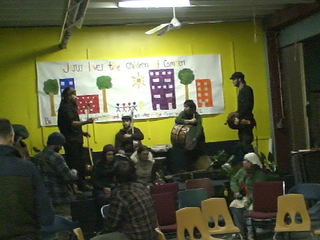
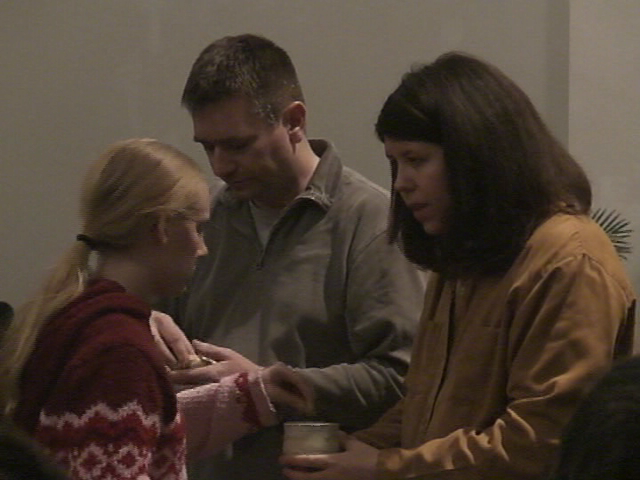
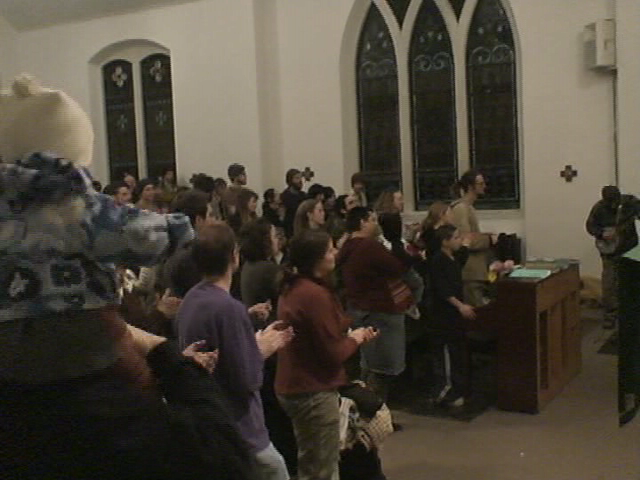
Here are some pictures from the Family Reunion this past weekend in Philadelphia.







Tuesday, February 13, 2007
Bad Hair=Good News!

This past weekend a group of us (Mike, Ya'el, John, Katheryn, Elizabeth, and I) attended the "Family Reunion" hosted by the Simple Way in Philadelphia. As always, it was a very inspiring time filled with a lot of great conversation, dreaming, scheming, fun, and reflection. I'll try to get some pictures up in the next few days and maybe share a little more about the actual gathering. But for now I wanted to share one particular anecdote that I thought was pretty cool. I think that Mike was really more deeply radicalized by this weekend, and the first place that this showed up was in his new hairstyling, prominently featured on the car trip homeward. On the last leg of the trip we stopped to get something to eat at a Wendy's in Huntington, West Virginia. I was ordering when I noticed Mike was sitting at a table with Ya'el and an elderly couple, and they seemed to be talking pretty intently. When I got my order I went over and sat down with them, and discovered that they were talking about the nature of our trip, with the older gentleman saying that he thought that he had read something about the Simple Way in a recent newspaper article. He and his wife kindly asked several questions relating to our beliefs on different points of Christian doctrine, seeking (it seemed) to weigh-out whether or not we believed in the "core" teachings of the Bible. It was a nice chat and I told them that I would send them some information to help them understand more about the movement that we were attempting to describe (New Monasticism). Anyhow, after we left the Wendy's, Mike told us that the older gentleman had been staring at him (really, his new hair), turning away quickly when Mike looked his way. He said that the real connection happened when he and Ya'el blessed the food. Apparently the older gentleman was pretty surprised by the combination of hair and holiness. At that point Mike invited he and his wife to join him at the table, and it was the beginning of a serendipitous connection between long lost family members. Anyhow, I think that I'd lost faith in the value of hair as a missionary tool. How I wish now that I still had some noteworthy hair. But that's all for now, I've actually got to get going so I can make my hair appointment!
Sunday, February 11, 2007
Frowning in February
A grey shade falls across the window panes;
it's either time for rain or for snow,
but we all know that the sun isn't shining today.
At least not here. Not in here.
Like the temperature, my mood is falling.
An imbalance in my body? Minus my soul my heart,
I'm simply a bundle of chemicals anyway.
That's not so bad, not so appalling.
I find myself frowning in February;
my mouth becomes a slide for my tears -
like a child emerging from a fort, slowly, intimidated -
until his feet hit the ground and he is absorbed.
it's either time for rain or for snow,
but we all know that the sun isn't shining today.
At least not here. Not in here.
Like the temperature, my mood is falling.
An imbalance in my body? Minus my soul my heart,
I'm simply a bundle of chemicals anyway.
That's not so bad, not so appalling.
I find myself frowning in February;
my mouth becomes a slide for my tears -
like a child emerging from a fort, slowly, intimidated -
until his feet hit the ground and he is absorbed.
Subscribe to:
Posts (Atom)