i came across this poem today. for the story behind it see this post.
wonderful to anticipate the joy of easter sunday....not long for you faithful lenten disciples...hang in there!
(this poem comes in 6 wonderfu parts...the following is part 2 - i'll try and post the rest before easter sunday)
Food for Risen Bodies
Michael Symmons Roberts
On that final night, his meal was formal:
lamb with bitter leaves of endive, chervil,
bread with olive oil and jars of wine.
Now on Tiberias' shores he grills
a carp and catfish breakfast on a charcoal fire.
This is not hunger, this is resurrection:
he eats because he can, and wants to
taste the scales, the moist flakes of the sea,
to rub the salt into his wounds.
Thursday, March 29, 2007


Wednesday, March 28, 2007
emergent book blog
(from sherry)
"an emergent manifesto of hope", the first book in emergent's 2007 collection, is out now and the publishers at baker books created a blog for contributors to post thoughts, ideas, etc that follow up from their chapters. communality can proudly boast that, of the 20 or so chapters in the book, there are three from our community - will samson, randy woodley and geoff & sherry. check out the blog - there's a piece from will and geoff.
see this link http://www.anemergentmanifestoofhope.com/
"an emergent manifesto of hope", the first book in emergent's 2007 collection, is out now and the publishers at baker books created a blog for contributors to post thoughts, ideas, etc that follow up from their chapters. communality can proudly boast that, of the 20 or so chapters in the book, there are three from our community - will samson, randy woodley and geoff & sherry. check out the blog - there's a piece from will and geoff.
see this link http://www.anemergentmanifestoofhope.com/
Sunday, March 25, 2007
lenten reflection
this was in our church newsletter here in australia (quoted from bishop arthur lichlenberger):
fast from criticism, and feast on praise;
fast from self-pity and feast on joy;
fast from ill-temper and feast on peace;
fast from resentment and feast on contentment;
fast from jealousy and feast on love;
fast from pride and feast on humility;
fast from selfishness and feast on service;
fast from fear, and feast on faith.
fast from criticism, and feast on praise;
fast from self-pity and feast on joy;
fast from ill-temper and feast on peace;
fast from resentment and feast on contentment;
fast from jealousy and feast on love;
fast from pride and feast on humility;
fast from selfishness and feast on service;
fast from fear, and feast on faith.
Thursday, March 22, 2007
Happy 40th John Fitgerald Kennedy Bruce-Papafio!

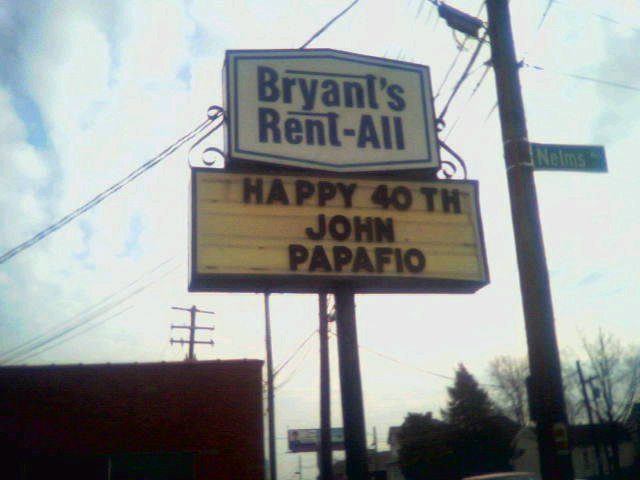
Thanks again to every one who helped us celebrate John's 40th birthday. It meant a lot to him and to us to receive all of the wonderful and creative cards and share a meal with many of John's closest friends. Maria made a special request to Bryant's Rent-All and they were finally able to fulfill it. This is a really neat service that they provide to the communtiy and it made John really happy.
Apathy's Lake
I wrote this poem in reflection of current going ons at the seminary as well as my trip to Washington, D.C. Enjoy.
Waters draw attention to reflection,
winds over waves whisper quiet promise;
behind me ancient paths call for travel
on narrow pathways and winding roads.
On the distant shore I can see the masses
leaping into the lake’s warm waters;
mindlessness grips their hearts and in they go
into the darkness of Apathy’s arms.
Turning from this place, I slowly return,
contemplating the welcoming warmth,
realizing that I am weeping from pain;
I weep for this burden of knowledge.
Apathy offers a promise of peace;
hers is a lie without a release.
Waters draw attention to reflection,
winds over waves whisper quiet promise;
behind me ancient paths call for travel
on narrow pathways and winding roads.
On the distant shore I can see the masses
leaping into the lake’s warm waters;
mindlessness grips their hearts and in they go
into the darkness of Apathy’s arms.
Turning from this place, I slowly return,
contemplating the welcoming warmth,
realizing that I am weeping from pain;
I weep for this burden of knowledge.
Apathy offers a promise of peace;
hers is a lie without a release.
Monday, March 19, 2007
Reflection on the War Protest


This past weekend, my buddy David and I drove up to Washington, D.C. to attend the Christian Peace Witness for Iraq – “United Under the Cross Against the War.” This was my first experience at protest. The event started with a worship service at the National Cathedral where 3000 Christians came together for worship. Admittedly, I’d never seen so many Christians united in the name of Jesus for anything. It was truly amazing! I think that there were about 5 mainline denominations represented.
Following the service, all 3000 people (or so it seemed) marched down Massachusetts Avenue toward the White House. As we marched down Embassy Row, it seemed as though the whole world was watching us as we proclaimed that America is not the way the truth and the life, but that Jesus Christ is. Watching the crowd meander down Massachusetts Ave. behind me was really a beautiful site, as people raised their faux candles and sang church camp songs and hymns the entire 3.6 miles. I think that my favorite part of the march was meeting Matt and Angela, a couple from Texas who are about to move to Reba House. Oh, and seeing the Psalters right behind me was great, too! But, I didn’t get to say much to them, as they were kind of setting the marching pace with their drums and tambourines. Oh, and Bill Mefford met us at the White House. That’s always a bonus!
When we got to the White House, things seemed to simmer down a bit. Over 100 people got arrested, but there didn’t seem to be any more cohesion to the group of 3000. Much of the arresting seemed staged, but I suppose that the police are used to such things by now.
On the way out of Arlington, on our way home, David asked me what I thought. In a tired, cynical voice, I said, “I just have to ask the ‘so what’ question. I’m not sure I understand what all of this effected.” It was a good experience all-in-all, but the main thing that I realized is something that Greg Leffel says on multiple occasions, “the kingdom is here but not in its fullness.” That’s how I felt this weekend. The kingdom is here, and maybe this was evidence of that fact, but sometimes it seems like the evidence that the kingdom of God is not here in its fullness is greater and heavier on my heart. Evidence like 1000s of people continuing to die because of the war in Iraq, and 1000s of people continuing to die in Darfur because there’s no oil there, or the statistics that we all know about food consumption in the United States, and the thing that seems to me to be the saddest is that so many of these things get boiled down to politics and that’s simply not the case. Yet, I must say that whether or not I can answer the “so what” question, I have to continue to stand for what is right, in the name of Jesus, because it seems that this is the Gospel thing to do.
Thursday, March 15, 2007
principles of compassion
(from sherry)
studying dave andrew's book, "not religion but love" has brought great challenge to me while providing a means for me to gather with other women to learn and encourage one another. we're only to chapter six and i'm barely coping under the weight of conviction. it is a good, simply-written book about life in the spirit of god and the compassion of jesus for the most marginalized and disadvantaged - the kind of compassion that builds relationships and brings about justice. this excerpt comes from a chapter titled "just practice."
"practising compassion, like christ, involves pratising principles that do justice to people. principles are not a substitute for passions. principles don't move us like passions do. but principles can guide our passions...chirst's principles give us a framework to help us think about what we feel about others...chirst shared his principles that were simple enough to understand and practical enough for anyone to be able to put them into practice.
don't make a show of your religion in order to attract attention to yourself. -matt 6:1
whenever you do someone a favour, don't tell the world about it. - matt 6:2
always treat other people as you would like them to treat you. - matt 7:12
do not treat children with contempt. - matt 18:10
treat older people with respect. - luke 18:20
just love your neighbour as yourself. - luke 10:27
how sad it is for you who neglect to do justice. - luke 11:42
stop judging people by mere appearances. - john 7:24
whoever want to be a leader should be a servant of all. - matt 20:26
studying dave andrew's book, "not religion but love" has brought great challenge to me while providing a means for me to gather with other women to learn and encourage one another. we're only to chapter six and i'm barely coping under the weight of conviction. it is a good, simply-written book about life in the spirit of god and the compassion of jesus for the most marginalized and disadvantaged - the kind of compassion that builds relationships and brings about justice. this excerpt comes from a chapter titled "just practice."
"practising compassion, like christ, involves pratising principles that do justice to people. principles are not a substitute for passions. principles don't move us like passions do. but principles can guide our passions...chirst's principles give us a framework to help us think about what we feel about others...chirst shared his principles that were simple enough to understand and practical enough for anyone to be able to put them into practice.
don't make a show of your religion in order to attract attention to yourself. -matt 6:1
whenever you do someone a favour, don't tell the world about it. - matt 6:2
always treat other people as you would like them to treat you. - matt 7:12
do not treat children with contempt. - matt 18:10
treat older people with respect. - luke 18:20
just love your neighbour as yourself. - luke 10:27
how sad it is for you who neglect to do justice. - luke 11:42
stop judging people by mere appearances. - john 7:24
whoever want to be a leader should be a servant of all. - matt 20:26
(short) politics rant
can you believe this?
"The federal minimum wage bill has been folded into the Iraq war spending legislation now before Congress. Whatever the political maneuvers that led to this situation, it is clear Congressional leadership has lost sight of the value of working men and women in our nation who have gone too long without a raise. " (read the rest here)
is it any wonder people (like me) are cynical about the political process? it seems near impossible to do justice. i am a long way from home right now but i hope (and trust) this has stirred some interest and passionate disgust in the US.
"The federal minimum wage bill has been folded into the Iraq war spending legislation now before Congress. Whatever the political maneuvers that led to this situation, it is clear Congressional leadership has lost sight of the value of working men and women in our nation who have gone too long without a raise. " (read the rest here)
is it any wonder people (like me) are cynical about the political process? it seems near impossible to do justice. i am a long way from home right now but i hope (and trust) this has stirred some interest and passionate disgust in the US.
Wednesday, March 07, 2007
An Uncommon Prayer
This is a prayer by our much-loved Michael Leunig, an Australian prophet and cartoonist. It is quoted at the start of a book I'm reading with a group of women here. The book is "Not Religion but Love - practising a radical spirituality of compassion" by Dave Andrews.
"God help us. With great skill and energy, we have ignored the state of the human heart. With eloquence and wit we have belittled the heart's wisdom. With politics and economics we have denied the heart's needs. With science and technology we have drowned out the voice of the soul. The primitive voice - the innocent voice - the truth.
We cannot hear the heart's truth, and thus we have betrayed and belittled ourselves and pledged madness to our children...We have made for ourselves an unhappy society.
It is timely that we give thanks for the lives of all prophets, teachers, healers, and revolutionaries, living and dead, acclaimed or obscure, who have rebelled, worked, and suffered for the cause of love and joy. We also celebrate that part of us, that part of us within ourselves, which has rebelled, worked, and suffered for the cause of love and joy.
God help us to change. To change ourselves and to change our world. To know the need for it. To deal with the pain of it. To feel the joy of it. To undertake the journey without understanding the destination.
That which is Christ-like within us shall be crucified. It shall suffer and be broken. And that which is Christ-like within us shall rise up. It shall love and create."
From A Common Prayer by Michael Leunig
(sherry)
"God help us. With great skill and energy, we have ignored the state of the human heart. With eloquence and wit we have belittled the heart's wisdom. With politics and economics we have denied the heart's needs. With science and technology we have drowned out the voice of the soul. The primitive voice - the innocent voice - the truth.
We cannot hear the heart's truth, and thus we have betrayed and belittled ourselves and pledged madness to our children...We have made for ourselves an unhappy society.
It is timely that we give thanks for the lives of all prophets, teachers, healers, and revolutionaries, living and dead, acclaimed or obscure, who have rebelled, worked, and suffered for the cause of love and joy. We also celebrate that part of us, that part of us within ourselves, which has rebelled, worked, and suffered for the cause of love and joy.
God help us to change. To change ourselves and to change our world. To know the need for it. To deal with the pain of it. To feel the joy of it. To undertake the journey without understanding the destination.
That which is Christ-like within us shall be crucified. It shall suffer and be broken. And that which is Christ-like within us shall rise up. It shall love and create."
From A Common Prayer by Michael Leunig
(sherry)
Monday, March 05, 2007
the greatest moral crisis of our age
Here is an article from Matthew...see this NY Times piece for the background.
Caring for Creation: The Greatest Moral Crisis of Our Age
J. Matthew Sleeth, MD
Jim Dobson is at it again. He and several conservative Christian groups sent a letter urging the National Association of Evangelicals to force its policy director in Washington to stop speaking out on global warming.
It’s time to stop this nonsense. As a physician, environmentalist, and evangelical Christian, I can state without reservation that global warming is real and that it is harming the least among us—our less fortunate global neighbors—disproportionately.
The Bible repeatedly commands us to demonstrate our love for the Creator by caring for His creation. We are further told to love our neighbor, particularly the least among us who are hurt most by our profligate use of resources, by stewarding God’s blessings wisely.
Until six years ago, I was director of an emergency room and chief of the medical staff of a beautiful hospital in New England. I had all the trappings of the American Dream—a big house in a postcard-perfect seaside village, two luxury cars, and lots of stuff. Then in one week’s time I admitted three women in their thirties with breast cancer, all to die. I decided that it was time to “stop running for the cure,” and to start looking for the cause.
A few months later, while on vacation, my wife asked me what I thought was the biggest problem facing the world today. I answered, “The earth is dying.” Then why we aren’t we doing something about it, she countered.
I thought I was. We had raised our children in cloth diapers, recycled religiously, and never driven anything more powerful than a four-cylinder car. But the Bible calls me to take the plank out of my own eye before I worry about the speck in my neighbor’s. So my family took an accounting and found that our energy usage was exactly average for America—which is unethically hoggish in global terms. Yes, compared to other physicians, my family was using less, but the Bible tells us to measure our lives against the example set by Jesus. When held against His humble life of service—Jesus never owned a home, had more than one cloak, or rode except on a borrowed colt, once—my consumerist lifestyle was indefensible.
Over the next year, my family embarked on a spiritual and environmental journey that resulted in us cutting back our electricity usage to one-tenth the national average and our fossil fuel use to one-third. We gave away half our possessions and moved into a house with the same footprint of our old garage. (Don’t feel too sorry for me; we had a big garage.) Along the way, my wife, two teenaged children, and I all were born again in a new and better life with God. I quit my job and began speaking, preaching, and writing full time about faith and the environment. Recently, my wife Nancy—who teaches at an evangelical Christian college—was talking to a young woman studying environmental science. Their family has owned the same 1400 acres in the Bible belt for a dozen generations, and they have always supported conservative politics. The young woman was being chided by her sister for investing so much of her energies in creation care. Like Dobson, her sister argued that other issues, like abortion and homosexuality, are more important. The college student replied that there will be no planet for any babies to be born on, or for any of these moral issues to be played out, if we do not start using our resources more wisely.
What this young woman was saying, and what many Christians are beginning to believe, is that caring for creation is the biggest moral crisis of our day. Like the slavery crisis of two centuries ago, we are importing cheap energy to support a lush lifestyle at the expense of our global neighbors, particularly those with fewer resources. And like the abolitionist movement, and the civil rights movement, we will need moral leadership from our faith communities if we have any hope of making significant change.
In January I was fortunate to speak at Wheaton College along with Sir John Houghton, the world’s preeminent climatologist, co-chair of the Intergovernmental Panel on Climate Change, and an evangelical Christian. He stated that China, India, and the emerging world are waiting to see what the United States will do about global warming. If we, with all our resources and wealth, are not willing to make some sacrifices, why should they? And Congress is waiting to see if the church will take on this issue. If their constituency, which is 85 percent Christian, doesn't care, why should they? And so, Sir John argues, the fate of the earth comes down to the evangelical Christian community in America. If we take on this issue, we will see a world-changing ripple effect. If not, there is little hope, especially for those inhabiting emerging nations.
Will humans survive global warming? The simple answer: Yes, but only those who can afford to. Rich countries will spend trillions of dollars adapting to the inevitable changes. People in poor countries will starve or migrate.
So what is the ethical response to global warming? As Christians, we—including Jim Dobson—should start by acknowledging our complicity. The vast majority of our resource consumption does nothing to glorify God. In fact, it does just the opposite.
As in any moral dilemma, evangelical Christians look to the Bible for wisdom. We are commanded to be the hands and feet of our Lord. In Christ’s most known sermon, given on a mountain, He tells us that “the meek shall inherit the earth.” We must set an example by the way we live our lives and steward limited resources. Are Americans of faith ready to put aside their squabbles and begin working together to solve the greatest moral issue of our day? Nothing less than the fate of God’s creation depends on our answer.
Dr. J. Matthew Sleeth is author of Serve God, Save the Planet, A Christian Call to Action, which is being released in softcover by Zondervan Publishing this month. For more information, see www.servegodsavetheplanet.org
Caring for Creation: The Greatest Moral Crisis of Our Age
J. Matthew Sleeth, MD
Jim Dobson is at it again. He and several conservative Christian groups sent a letter urging the National Association of Evangelicals to force its policy director in Washington to stop speaking out on global warming.
It’s time to stop this nonsense. As a physician, environmentalist, and evangelical Christian, I can state without reservation that global warming is real and that it is harming the least among us—our less fortunate global neighbors—disproportionately.
The Bible repeatedly commands us to demonstrate our love for the Creator by caring for His creation. We are further told to love our neighbor, particularly the least among us who are hurt most by our profligate use of resources, by stewarding God’s blessings wisely.
Until six years ago, I was director of an emergency room and chief of the medical staff of a beautiful hospital in New England. I had all the trappings of the American Dream—a big house in a postcard-perfect seaside village, two luxury cars, and lots of stuff. Then in one week’s time I admitted three women in their thirties with breast cancer, all to die. I decided that it was time to “stop running for the cure,” and to start looking for the cause.
A few months later, while on vacation, my wife asked me what I thought was the biggest problem facing the world today. I answered, “The earth is dying.” Then why we aren’t we doing something about it, she countered.
I thought I was. We had raised our children in cloth diapers, recycled religiously, and never driven anything more powerful than a four-cylinder car. But the Bible calls me to take the plank out of my own eye before I worry about the speck in my neighbor’s. So my family took an accounting and found that our energy usage was exactly average for America—which is unethically hoggish in global terms. Yes, compared to other physicians, my family was using less, but the Bible tells us to measure our lives against the example set by Jesus. When held against His humble life of service—Jesus never owned a home, had more than one cloak, or rode except on a borrowed colt, once—my consumerist lifestyle was indefensible.
Over the next year, my family embarked on a spiritual and environmental journey that resulted in us cutting back our electricity usage to one-tenth the national average and our fossil fuel use to one-third. We gave away half our possessions and moved into a house with the same footprint of our old garage. (Don’t feel too sorry for me; we had a big garage.) Along the way, my wife, two teenaged children, and I all were born again in a new and better life with God. I quit my job and began speaking, preaching, and writing full time about faith and the environment. Recently, my wife Nancy—who teaches at an evangelical Christian college—was talking to a young woman studying environmental science. Their family has owned the same 1400 acres in the Bible belt for a dozen generations, and they have always supported conservative politics. The young woman was being chided by her sister for investing so much of her energies in creation care. Like Dobson, her sister argued that other issues, like abortion and homosexuality, are more important. The college student replied that there will be no planet for any babies to be born on, or for any of these moral issues to be played out, if we do not start using our resources more wisely.
What this young woman was saying, and what many Christians are beginning to believe, is that caring for creation is the biggest moral crisis of our day. Like the slavery crisis of two centuries ago, we are importing cheap energy to support a lush lifestyle at the expense of our global neighbors, particularly those with fewer resources. And like the abolitionist movement, and the civil rights movement, we will need moral leadership from our faith communities if we have any hope of making significant change.
In January I was fortunate to speak at Wheaton College along with Sir John Houghton, the world’s preeminent climatologist, co-chair of the Intergovernmental Panel on Climate Change, and an evangelical Christian. He stated that China, India, and the emerging world are waiting to see what the United States will do about global warming. If we, with all our resources and wealth, are not willing to make some sacrifices, why should they? And Congress is waiting to see if the church will take on this issue. If their constituency, which is 85 percent Christian, doesn't care, why should they? And so, Sir John argues, the fate of the earth comes down to the evangelical Christian community in America. If we take on this issue, we will see a world-changing ripple effect. If not, there is little hope, especially for those inhabiting emerging nations.
Will humans survive global warming? The simple answer: Yes, but only those who can afford to. Rich countries will spend trillions of dollars adapting to the inevitable changes. People in poor countries will starve or migrate.
So what is the ethical response to global warming? As Christians, we—including Jim Dobson—should start by acknowledging our complicity. The vast majority of our resource consumption does nothing to glorify God. In fact, it does just the opposite.
As in any moral dilemma, evangelical Christians look to the Bible for wisdom. We are commanded to be the hands and feet of our Lord. In Christ’s most known sermon, given on a mountain, He tells us that “the meek shall inherit the earth.” We must set an example by the way we live our lives and steward limited resources. Are Americans of faith ready to put aside their squabbles and begin working together to solve the greatest moral issue of our day? Nothing less than the fate of God’s creation depends on our answer.
Dr. J. Matthew Sleeth is author of Serve God, Save the Planet, A Christian Call to Action, which is being released in softcover by Zondervan Publishing this month. For more information, see www.servegodsavetheplanet.org
Wednesday, February 28, 2007
paradise
i checked out a johnny cash 2-disc yesterday at the library and have been enjoying the old school tunes. one in particular was catchy, but told a pretty sad story. it's called "paradise" and is the cover of an old john prine song. it has a bit of a mountain top removal theme. since geoff's been out of town i haven't been paying much attention to the subject of mtr. this was a good reminder of what's going on to land that's so close. and to be mindful of the electricity that we use on a daily basis. in kentucky, 97% of electricity comes from coal. more kentucky mtr facts.
PARADISE by JOHN PRINE
When I was a child my family would travel
Down to Western Kentucky where my parents were born
And there's a backwards old town that's often remembered
So many times that my memories are worn.
Chorus:
And daddy won't you take me back to Muhlenberg County
Down by the Green River where Paradise lay
Well, I'm sorry my son, but you're too late in asking
Mister Peabody's coal train has hauled it away
Well, sometimes we'd travel right down the Green River
To the abandoned old prison down by Adrie Hill
Where the air smelled like snakes and we'd shoot with our pistols
But empty pop bottles was all we would kill.
Then the coal company came with the world's largest shovel
And they tortured the timber and stripped all the land
Well, they dug for their coal till the land was forsaken
Then they wrote it all down as the progress of man.
When I die let my ashes float down the Green River
Let my soul roll on up to the Rochester dam
I'll be halfway to Heaven with Paradise waitin'
Just five miles away from wherever I am.
PARADISE by JOHN PRINE
When I was a child my family would travel
Down to Western Kentucky where my parents were born
And there's a backwards old town that's often remembered
So many times that my memories are worn.
Chorus:
And daddy won't you take me back to Muhlenberg County
Down by the Green River where Paradise lay
Well, I'm sorry my son, but you're too late in asking
Mister Peabody's coal train has hauled it away
Well, sometimes we'd travel right down the Green River
To the abandoned old prison down by Adrie Hill
Where the air smelled like snakes and we'd shoot with our pistols
But empty pop bottles was all we would kill.
Then the coal company came with the world's largest shovel
And they tortured the timber and stripped all the land
Well, they dug for their coal till the land was forsaken
Then they wrote it all down as the progress of man.
When I die let my ashes float down the Green River
Let my soul roll on up to the Rochester dam
I'll be halfway to Heaven with Paradise waitin'
Just five miles away from wherever I am.
Tuesday, February 27, 2007
contaminations
Dad passed an article on to be by Ron Nikkel (president of Prison Fellowship International). you can find his past articles here - it is part Nikkel's 'Conversatio Morum' newsletter series and is entitled 'Contaminations'.
his reflection surrounds Jesus warning to his disciples, "beware of the yeast of the pharisees" (Matt. 16:6). This article is particularly interesting given that his former boss, Chuck Colson, has been one of the more outspoken 'friends' of the current administration (which of course offers the same risks to Christians as all the previous administrations). here are the last few paragraphs. i'm very challenged by it thinking through my own expectations for world peace or my own need for bread.
"One day as Jesus was preparing to launch out across the sea, his disciples were arguing amongst themselves about the lack of planning and preparation for their voyage. There was no lunch for the journey – whose responsibility was it anyhow? What good was a single loaf of bread between them? “Beware of the contaminating influence of the Pharisees and of Herod,” Jesus remarked as he stepped into the boat with them. Somewhat perplexed by his comment, the disciples muttered to themselves, “It must be because we did not bring the bread.” On hearing their continuing argument Jesus asked them to recall the recent feeding of the multitudes when but a single lunch had been available and yet sufficient to feed thousands. How quickly the lesson of trusting in God’s power and provision had been forgotten.
How easily we, like the disciples, become contaminated by the ways of the Pharisees and of Herod in our day. The contaminating influence of thinking like Pharisees lies in acting as if true religion is about believing, speaking, and doing the accepted and prescribed things of faith – and that God cares only for the good and for things beyond our reach. When the Pharisees were confronted with Jesus, who acted “outside that religious box,” again and again they demanded a miraculous sign -- real proof. How could the holy God of heaven possibly involve himself with the simple mundane needs of life like bread and wine, or stoop to care for loose women or Iraqi insurgents? But the fact is that God did – and still does.
The contamination of Herod is not religious at all, but down to earth and most pragmatic. It is all about being competent and in control – mastering the details of our own lives and those of others. Politics and performance becomes god-of-the-day under whom we assume responsibility for ourselves and the world. We bless and blame our own effort and responsibility as if lunch and life and the state of nations are completely in the hands of our own responsibility.
Beware of the contaminating influence of the Pharisees, by which we marginalize God to the higher things of heaven, disinterested in rough, routine and earthly stuff like the bread we need for the voyage or the lives of suicide bombers who threaten us in Afghanistan. Beware of the contaminating influence of Herod, by which we replace God with our own political sensibility and the competence of our own planning and preparation to secure bread for lunch and oil for our cars.
Believe in God, trust God – the One who turned water into wine for a wedding; who fed a multitude with a few loaves and fish; who dared to touch an unclean leper; who dined with sinners and prostitutes; who calmed the stormy sea – He is the God who cares for you in all the places and circumstances of your life."
his reflection surrounds Jesus warning to his disciples, "beware of the yeast of the pharisees" (Matt. 16:6). This article is particularly interesting given that his former boss, Chuck Colson, has been one of the more outspoken 'friends' of the current administration (which of course offers the same risks to Christians as all the previous administrations). here are the last few paragraphs. i'm very challenged by it thinking through my own expectations for world peace or my own need for bread.
"One day as Jesus was preparing to launch out across the sea, his disciples were arguing amongst themselves about the lack of planning and preparation for their voyage. There was no lunch for the journey – whose responsibility was it anyhow? What good was a single loaf of bread between them? “Beware of the contaminating influence of the Pharisees and of Herod,” Jesus remarked as he stepped into the boat with them. Somewhat perplexed by his comment, the disciples muttered to themselves, “It must be because we did not bring the bread.” On hearing their continuing argument Jesus asked them to recall the recent feeding of the multitudes when but a single lunch had been available and yet sufficient to feed thousands. How quickly the lesson of trusting in God’s power and provision had been forgotten.
How easily we, like the disciples, become contaminated by the ways of the Pharisees and of Herod in our day. The contaminating influence of thinking like Pharisees lies in acting as if true religion is about believing, speaking, and doing the accepted and prescribed things of faith – and that God cares only for the good and for things beyond our reach. When the Pharisees were confronted with Jesus, who acted “outside that religious box,” again and again they demanded a miraculous sign -- real proof. How could the holy God of heaven possibly involve himself with the simple mundane needs of life like bread and wine, or stoop to care for loose women or Iraqi insurgents? But the fact is that God did – and still does.
The contamination of Herod is not religious at all, but down to earth and most pragmatic. It is all about being competent and in control – mastering the details of our own lives and those of others. Politics and performance becomes god-of-the-day under whom we assume responsibility for ourselves and the world. We bless and blame our own effort and responsibility as if lunch and life and the state of nations are completely in the hands of our own responsibility.
Beware of the contaminating influence of the Pharisees, by which we marginalize God to the higher things of heaven, disinterested in rough, routine and earthly stuff like the bread we need for the voyage or the lives of suicide bombers who threaten us in Afghanistan. Beware of the contaminating influence of Herod, by which we replace God with our own political sensibility and the competence of our own planning and preparation to secure bread for lunch and oil for our cars.
Believe in God, trust God – the One who turned water into wine for a wedding; who fed a multitude with a few loaves and fish; who dared to touch an unclean leper; who dined with sinners and prostitutes; who calmed the stormy sea – He is the God who cares for you in all the places and circumstances of your life."
Tuesday, February 20, 2007
I'm Not Icharus
I wish I was just standing on the edge today, but I must say that it feels more like I'm running.
Peering to the left I see the cavernous depth drop below, like the gullet of a hungry monster opening for a gulp.
Run, run, running I am from everything I thought I used to know; is this the place to where, with the wind, I'm blown?
Any more force and over the edge I shall go.
Oh, to have wings on my ankles, I'd fly through the sky with the wisdom of hindsight.
I want to tell my story without someone else holding the pen; I want to jump off of this ledge without the darkness below; I want to fly high but not to burning heights.
I want to be free, but I'm not Icharus,
so maybe I'll put out my sails and find out where the wind will blow.
"The wind blows where it chooses, and you hear the sound of it, but you do not know where it comes from or where it goes. So it is with everyone who is born of the Spirit" (John 3:8).
(from Dan Lowe)
Peering to the left I see the cavernous depth drop below, like the gullet of a hungry monster opening for a gulp.
Run, run, running I am from everything I thought I used to know; is this the place to where, with the wind, I'm blown?
Any more force and over the edge I shall go.
Oh, to have wings on my ankles, I'd fly through the sky with the wisdom of hindsight.
I want to tell my story without someone else holding the pen; I want to jump off of this ledge without the darkness below; I want to fly high but not to burning heights.
I want to be free, but I'm not Icharus,
so maybe I'll put out my sails and find out where the wind will blow.
"The wind blows where it chooses, and you hear the sound of it, but you do not know where it comes from or where it goes. So it is with everyone who is born of the Spirit" (John 3:8).
(from Dan Lowe)
it's worth doing nothing and having a rest
this is dedicated to my dear friend mr ryan koch...and to all my communality family who struggle with an overactive protestant work ethic (you might not know who you are...ask ryan).
thanks to Simon Carey Holt (prof. of practical theology at Ridley in Melbourne).
(From Mr. Curly to Vasco Pyjama)
Dear Vasco,
In response to your question, “What is worth doing and what is worth having?” I would like to say simply this. It is worth doing nothing and having a rest; in spite of all the difficulty it may cause, you must rest, Vasco — otherwise you will become RESTLESS! I believe the world is sick with exhaustion and dying of restlessness.
While it is true that periods of weariness help the spirit to grow, the prolonged, ongoing state of fatigue, to which our world seems to be rapidly adapting, is ultimately soul-destroying as well as earth-destroying. The ecology of evil flourishes and love cannot take root in this sad situation. Tiredness is one of our strongest, most noble and instructive feelings. It is an important aspect of our CONSCIENCE and must be heeded or else we will not survive.
When you are tired you must HAVE that feeling and you must act upon it sensibly — you MUST rest like the trees and animals do. Yet tiredness has become a matter of shame! This is a dangerous development. Tiredness has become the most suppressed feeling in the world. Everywhere we see people overcoming their exhaustion and pushing on with intensity — cultivating the great mass mania which all around is making life so hard and ugly — so cruel and meaningless — so utterly graceless — and being congratulated for overcoming it and pushing it deep down inside themselves as if it were a virtue to do this.
And of course, Vasco, you know what happens when such strong and natural feelings are denied — they turn into the most powerful and bitter poisons with dreadful consequences. We live in a world of these consequences and then wonder why we are so unhappy.
So I gently urge you, Vasco, do as we do in Curly Flat — learn to curl up and rest — feel your noble tiredness — learn about it and make a generous place for it in your life and enjoyment with surely follow.
I repeat: it’s worth doing nothing and having a rest.
Yours sleepily, Mr. Curly x x x
The Curly Pyjama Letters (by Michael Leunig,Viking, 2001, 26-28.)
thanks to Simon Carey Holt (prof. of practical theology at Ridley in Melbourne).
(From Mr. Curly to Vasco Pyjama)
Dear Vasco,

In response to your question, “What is worth doing and what is worth having?” I would like to say simply this. It is worth doing nothing and having a rest; in spite of all the difficulty it may cause, you must rest, Vasco — otherwise you will become RESTLESS! I believe the world is sick with exhaustion and dying of restlessness.
While it is true that periods of weariness help the spirit to grow, the prolonged, ongoing state of fatigue, to which our world seems to be rapidly adapting, is ultimately soul-destroying as well as earth-destroying. The ecology of evil flourishes and love cannot take root in this sad situation. Tiredness is one of our strongest, most noble and instructive feelings. It is an important aspect of our CONSCIENCE and must be heeded or else we will not survive.
When you are tired you must HAVE that feeling and you must act upon it sensibly — you MUST rest like the trees and animals do. Yet tiredness has become a matter of shame! This is a dangerous development. Tiredness has become the most suppressed feeling in the world. Everywhere we see people overcoming their exhaustion and pushing on with intensity — cultivating the great mass mania which all around is making life so hard and ugly — so cruel and meaningless — so utterly graceless — and being congratulated for overcoming it and pushing it deep down inside themselves as if it were a virtue to do this.
And of course, Vasco, you know what happens when such strong and natural feelings are denied — they turn into the most powerful and bitter poisons with dreadful consequences. We live in a world of these consequences and then wonder why we are so unhappy.
So I gently urge you, Vasco, do as we do in Curly Flat — learn to curl up and rest — feel your noble tiredness — learn about it and make a generous place for it in your life and enjoyment with surely follow.
I repeat: it’s worth doing nothing and having a rest.
Yours sleepily, Mr. Curly x x x
The Curly Pyjama Letters (by Michael Leunig,Viking, 2001, 26-28.)
seeing the light
(we posted this over at our family blog also)
great news today from the australian federal government. they are phasing out the old-style light bulbs. see the story
here.
good on you, aussies.
(geoff)
great news today from the australian federal government. they are phasing out the old-style light bulbs. see the story
here.
good on you, aussies.
(geoff)
Subscribe to:
Posts (Atom)